SYOKOVERSE
I should get around to giving the world a better name. For now... Welcome to the Syokoverse.
World is cast in Medieval / Fantasy era where magic exists and gods walk among mortals. They are five major races where Humankind has spread becoming the dominant species.Races | Cities | Myth
The major races are:
Minor race:
These are just a few of the Cities that exist in the world:
These are just a few of the locations that exist in the world:
The Beginning
In the silent, formless expanse before time, a new realm shimmered into being—a lone jewel in the void. Ancient, primordial beings of pure element, existing beyond comprehension, took notice. Desiring to claim this untouched reality for their own, they forged four mighty Avatars as their instruments: the Avatar of Fire, the Avatar of Water, the Avatar of Air, and the Avatar of Earth. Each was sent forth to dominate the realm, and their cataclysmic clash tore the fabric of the nascent world asunder.Unknown to the Ancient Ones, the realm already had guardians: twin foxes born of its first breath. A radiant White Fox embodied the aspect of Life, and a shadowy Black Fox embodied the aspect of Death. They watched in sorrow as their home became a battlefield. Yet, from this destruction, creation bloomed. The slain elemental essences of the Avatars coalesced into stars and planets, forming the fledgling universe. The Black Fox dutifully gathered the expended energy of the fallen, and the White Fox used this collected essence to weave new life—first plants and beasts, then the Beastfolk.From the Beastfolk, some lost their animal traits, becoming the first Humans. Some Humans became enveloped in pure mana, evolving into the Elves, while others were shunned from the light, hardening into the resilient Dwarves. The Black Fox, ever the collector of souls, grew envious of the White Fox's creative power and protested, longing to create. The White Fox agreed, but on one condition: in return for the power to create, the White Fox must be granted the power to destroy.The Black Fox created the Demons, a race crafted from the strengths of all others: the adaptability of Humans and Beastfolk, the mana affinity and longevity of Elves, and the ingenuity of Dwarves—a "perfect" race. The White Fox, though displeased with this ambitious creation, honored the pact. When asked what it wished to destroy, the White Fox revealed the ultimate cost of creation: to achieve true peace, it would destroy itself and the remaining Avatars. Though heartbroken, the Black Fox was bound by its promise.In a final, glorious act of sacrifice, the White Fox unleashed its power, destroying itself and the elemental Avatars. From their dissipated energies, seven new gods were born, each inheriting a fragment of the primordial and guardian powers:Flash, God of AirFelicia, Goddess of WaterSkoal, God of FireSkye, Goddess of EarthGenerate, God of EnergyCharlie, Goddess of LifeFiasco, God of DeathThese seven gods descended to the planet Syoko to practice and hone their divine powers. In a fateful twist, Flash, the God of Air, fell in love with a Demoness. His siblings scorned this mortal love, but from their union, a daughter was born. The Demoness perished in childbirth, and the child, born from both life and death, was named Syoko after the world itself.Seeing the young Syoko's profound affinity for water, the goddess Felicia selflessly abdicated her domain, allowing Syoko to ascend as the new Goddess of Water. Felicia herself transformed, becoming the Goddess of Ice. As the now eight gods began building their celestial city, a mortal Human heroine, Motoko, challenged them. Acknowledging her unparalleled skill and spirit, Flash offered her his own domain. He elevated her to become the Goddess of Air, while he selfishly ascended to a higher plane as the God of Gods, proving that mortality is no barrier to divinity.Now, the nine gods reside in their majestic Spire in Xiao Tian, overseeing the world of Syoko—a testament to sacrifice, love, and the endless cycle of creation and destruction.
Slavery
Humanity’s dominion is enforced by more than chains—it is etched into flesh and magic. To prevent escape, slavers have turned to a cruel and unbreakable binding: the Slave Crest, a searing mark burned into a slave’s chest, forged from their master’s blood. Once branded, the slave is bound in soul as much as body—unable to disobey a direct command, even if it means tearing out their own heart. The Crest glows crimson with every enforced order, a permanent reminder of their bondage. No blade can cut it, no mage can unravel it. A slave is a slave for life.Slave spell ritual:
1. Blood is required from the new master.
2. Smear blood onto the slave's chest (or crest if one is already present).
3a. If a new slave (no crest), the new master speaks an incantation binding the slave to them.
3b. If a current or past slave (crest already present), the old master must give a command of transfer while the new owner recites the incantation.
3c. If the old master is dead (inactive crest), the new master smears their blood across the crest reactivating it.Slave spell rules:
1. Slave is bonded to their master by blood. They are unable to bring harm onto their master.
2. Slave must follow any words from the master.
3. Slave crest is eternal, a permanent mark upon their body and soul. It may be active or inactive, but it will always be there.
4. Death of the master will make the crest inactive.
5. Masters using words that introduce choice (MAY, WOULD, COULD, etc...) will not force the slave to perform the command.
6. SECRET: It IS possible to "free" a slave, although the crest will still be visible and active. The slave ritual could be performed using 3b. Where the slave would be the new target master. Essentially making the slave a master of themselves. (side note: suicide is no longer possible as it would conflict with rule #1)
Humans
Primary Motto: "From Ashes, We Build. From Questions, We Advance."I. The Unanswered Question: Origin & Soul
Humans are a race defined by their unknown past and their pragmatic present. Unlike other races with clear creation myths, humanity's origin is a matter of faith and debate. This fundamental uncertainty is the core driver of their nature.* The Empty Chronicle: There is no unified human creation myth. Some preachers claim they were the final, perfected creation of a pantheon of Nine Gods. Scholars point to fossil records and suggest a mundane, evolutionary origin from lesser primates. This lack of a divine "deed" to the world leaves them with a lingering insecurity—a need to prove their right to exist through action and dominion.
* A Functional Afterlife: Belief in an afterlife is common, but its nature is as varied as their origins. It is generally seen as a reward for a life well-lived, but the specifics are left to individual faith. This makes humans intensely focused on their mortal legacy—building a family, acquiring wealth, and leaving a mark on the world that will outlast them. The question of the soul is less important than the deeds done while it is housed in the body.
* The Self-Made Individual (Within the Collective): Human philosophy is a paradox. They are a collectivist species when it comes to family and nation, expecting individuals to contribute to the whole. However, they deeply admire and reward individual cunning, ambition, and success. Your identity is inherited through your family name, but your worth is earned by what you achieve for yourself and, by extension, your lineage.II. The Mortal Coil: Biology & Its Imperatives
Humanity's relatively short, fragile lifespan shapes every aspect of their culture around urgency, reproduction, and resilience.* The Rush of Years: With a lifespan of 80-90 years, humans feel time slipping through their fingers. This creates a cultural pressure to "make your mark" quickly. They are impulsive, ambitious, and impatient, often frustrating longer-lived races like Elves with their frantic pace. They form deep bonds quickly and mourn intensely, as they have little time to spare.
* Family as Fortress: The imperative to reproduce is a direct response to their mortality. Large families are a form of security and immortality—a way to ensure one's bloodline and memory endure. The cultural push for at least one male heir stems from patriarchal structures where family name and property are passed down through sons. The "standard" unit is a nuclear family, but it exists within a vast, supportive, and often interfering extended family network.
* The Spark of Potential: All humans possess a spark of magic, but its potential is wildly unpredictable. This has led them to not rely on it. Instead, their innate ability is ingenuity—a relentless curiosity to solve problems through tools, engineering, strategy, and social manipulation. A human with no magic is not an outcast; they are simply expected to be cleverer with their hands or their words.
* Omnivorous Ambition: Humans are opportunistic omnivores, a trait that has allowed them to thrive in almost any environment. Their cuisine is a reflection of their social status: the poor subsist on bread and grain, the middle class values meat, and the elite flaunt their wealth with rare spices and sugar. Mead and ale are staples, fueling both celebrations and quiet despair.III. The Structures of Power: Society & Governance
Human society is a rigid, hierarchical pyramid designed for stability and expansion.* Rule by Blood and Gold: Humans are typically governed by monarchs (Kings and Queens) whose divine right to rule is reinforced by immense wealth and powerful lineages. This trickles down into a feudal-like structure where nobility, merchants, and military leaders jockey for power and influence.
* The Currency of Status: Status is derived from two things: Lineage (old blood and a respected name) and Wealth (new money and influence). A wealthy merchant can buy a title, and a noble with no coin is a figurehead without power. Military prowess, wisdom, and magical strength are paths to gaining wealth and status, but they are not valued in and of themselves without the resulting material gain.
* The Gilded Cage: Gender roles are strictly defined but navigated with cunning.
* Men are the public face: soldiers, rulers, merchants, and craftsmen. Their value is tied to their provision and protection.
* Women are the architects of the private sphere: managing the household, raising the next generation, and upholding social traditions. In high society, their power is subtle but immense—they weave the social networks that influence policy and secure alliances through marriage and "quiet words" with their husbands. It is a system of overt patriarchy maintained by covert matriarchy.
* Coming of Age: Adulthood is earned through utility.
* Men become adults around 16 when they take on economic responsibility, often apprenticing or joining the military. Manhood is synonymous with providing.
* Women are considered adults at menarche, their biological readiness for marriage and motherhood marking their social transition. Womanhood is synonymous with nurturing and managing.IV. The Human Heart: Culture & Expression
* Core Values: Cunning, Tradition, Freedom, Knowledge.
* Greatest Virtue: Helpfulness. In a dangerous world, communal survival is paramount. The individual who aids their neighbor, family, or nation without being asked is praised above all. This is often a pragmatic helpfulness—helping others strengthens the collective, which in turn protects the individual.
* Greatest Taboo: Murder. The unlawful killing of another human is the ultimate crime, as it robs the victim of their limited time and the community of a member. It is a waste of precious life and a destabilizing act against the social order.
* Aesthetics of Order: Human art, architecture, and fashion are symmetrical, geometric, and ornate. This reflects their desire to impose order on a chaotic world. Complexity and decoration are direct displays of wealth and power. A ornate, symmetrical castle isn't just a home; it's a statement of control.
* Linguistic Tells: Their language reveals their prejudices and beliefs.
* The term "Demi" for Beastfolk is a linguistic tool of dehumanization, placing them in a separate, lesser category.
* Exclamations like "By the Nine!" constantly reinforce their cultural connection to their pantheon of gods, even in the absence of a unified creation myth.V. A World of "Demi-Humans": Worldview & Relations
Humans view the world through a lens of hierarchical supremacy.* The Default Setting: Supremacy. The default human attitude towards other races is that they are "demi-human"—lesser versions of the "complete" human form. This justifies their imperialistic and mercantile tendencies.
* Elves: Viewed with jealous contempt. Their long lives and innate magic are seen as "wasted" on a stagnant, passive culture. Humans covet what Elves have but dismiss how they use it.
* Dwarves: Tolerated Allies. Respected for their unparalleled craftsmanship and pragmatic nature. The relationship is transactional and stable.
* Beastfolk: Despised and Enslaved. Considered little more than intelligent animals. The term "demi" is used to rationalize their exploitation as laborers, soldiers, and pets.
* Demons: Feared and Manipulated. After defeating them in war, humans now rule the demons through a puppet leader. The relationship is one of tense, wary domination.
* Undead: Abominations. The ultimate perversion of humanity's precious mortal lifespan. They are destroyed on sight out of fear and religious revulsion.
* How They Are Perceived:
* By Beastfolk: Slavers. Masters. Oppressors.
* By Elves: Ephemeral. Hasty. A loud, chaotic, and briefly flickering candle. They are beneath long-term consideration.
* By Dwarves: Good customers. Short-sighted but enthusiastic partners in trade and drink. Their ambitions are noted, but not yet a concern.
* By Demons: The victors. Cunning, ruthless, and dangerous. They are to be obeyed until an opportunity for rebellion arises.
* Integration: Humans are cultural chameleons. They can assimilate into any society, not out of respect, but as a strategy to learn, trade, and eventually gain influence. A human-majority enclave in an Elf city would slowly begin to shift local customs to be more human.VI. The Driving Spirit: Philosophy & Psychology
* View on Change: Progress and Innovation. Tradition is respected, but it is a foundation to build upon, not a cage to live in. Humans are never satisfied with "good enough"; they always ask, "What's next?"
* View on Conflict: War is a last resort—it is expensive and wastes the lives that are their primary resource. However, deception is a first resort and is seen as the height of cleverness. To be tricked is a personal failing of the victim for being gullible.
* Concept of Time: Future-Oriented. Humans are always planning, building, and investing for a future they themselves may not live to see. They are the race that plants trees whose shade they will never sit under.
* Humor: Rooted in irony and relatability. They laugh at the incongruities of life and the universal struggles of mortality. Their humor is a bonding mechanism, a way to acknowledge shared struggles in a difficult world.
* Agency: Humans are the ultimate proponents of self-determination. They believe they forge their own destiny. This belief is the source of their greatest ambition, their most terrible crimes, and their most glorious achievements. They are not pieces on a board; they are the players, desperately trying to change the rules of the game.VII. Notable Humans
Elves
Primary Motto: "A thousand years is but a moment to perfect a single thought."I. The Ascended Accident: Origin & Soul
The Elves see themselves as a race perfected by chance, a superior evolution of base mankind. This belief is the bedrock of their arrogance and their isolationism.* The Refined Strain: Their creation myth states they were not made by gods, but elevated. They believe that during the primordial War of the Ancients, a group of humans was bathed in a font of the purest, most concentrated mana. This event didn't create a new race so much as it purged the imperfections from an existing one, resulting in a longer-lived, magically potent, and intellectually superior species: the Elves. They see themselves not as cousins to humanity, but as their ultimate form.
* A Purpose of Happenstance: They acknowledge their origin was an accident, a "byproduct of happenstance." This has led to a philosophical belief that they have no grand, divine purpose. Instead, their purpose is self-determined: to pursue perfection in magic, knowledge, and art, and to preserve their refined state from the corruption of the lesser races.
* The Returning Soul: They believe their souls are concentrated essence of pure magic. Upon death, this energy is not judged but simply returns to the universal soul stream, dissipating back into the background magic of the world. This belief fosters a calm, dispassionate acceptance of death—it is not an end, but a return. It also means they feel no great urgency to leave a legacy; their long lives are legacy enough.
* The Sovereign Individual (Within the Collective): Elven philosophy is a paradox of individualism within a rigid structure. They value individual pursuit of mastery and knowledge above all else. However, this pursuit must conform to the strict hierarchies and traditions set by the ruling High Elves. You are free to be an individual, as long as you are obedient to your betters. Identity is inherited through lineage, but your worth is earned by your personal magical and intellectual achievements.II. The Ageless Vessel: Biology & Its Imperatives
Their near-immortality and magical nature fundamentally divorce them from the struggles and drives of mortal races.* The Weight of Millennia: With lifespans reaching 2,000 years, Elves perceive time on a geological scale. They are patient to the point of appearing stagnant. A project that takes a human lifetime is a brief diversion to an Elf. This breeds a profound sense of superiority and a dismissive attitude toward the "ephemeral" races, whose lives are too short to form "meaningful" bonds or master complex arts.
* The Disposable Family Unit: The concept of a nuclear family is alien. With such long lives, permanent partnerships are rare. Reproduction is an infrequent, contractual agreement between individuals to create a new life before parting ways to continue their personal pursuits. The child is raised by the community, specifically by lower-status Elves tasked with such duties, until they are old enough to be independent. Emotional attachment is seen as a mortal, and therefore lesser, weakness.
* Innate Magical Superiority: Every Elf is born with a deep well of magical potential. It is as natural to them as breathing. Not having this ability is unthinkable; an Elf without magic would be considered a cripple or a throwback—a "Mane-blooded"—and would be hidden away or exiled in shame.
* A Diet of Essence: While they can eat physical food, they see it as a crude necessity. They can sustain themselves for long periods on ambient mana alone, often supplementing their diet with mana-infused fruits and wines. Eating is not a social or pleasurable activity but a maintenance chore, a distraction from more important intellectual pursuits.III. The Gilded Hierarchy: Society & Structure
Elven society is a beautiful, static, and deeply stratified crystal, designed to minimize disruption and maximize the pursuit of refined goals.* Rule by the Eternal Council: Governance is handled by a Council of Elders. However, due to their longevity, this council rarely changes membership. Over centuries, it ossifies into a de facto aristocracy—the High Elves—who rule based on the unassailable pillars of Lineage and Magical Power. Their rule is absolute, traditionalist, and resistant to any change that might threaten their status.
* The Hierarchy of Blood and Power: Status is defined by two factors: the purity of your Lineage (direct descent from the original "ascended" families) and the strength of your Magical Power. There is little social mobility. A powerful Mage from a lower lineage might gain respect as a useful tool, but they will never be considered a true equal to a High Elf of pure blood. Wealth, military prowess, and wisdom are secondary to these two pillars.
* The Erasure of Gender: Due to their extremely low birth rate, all Elves are expected to contribute to society's continuation. There are no strict gender roles; the concepts of "male" and "female" duties are seen as primitive. All are equally expected to master their chosen craft, be it magic, art, or governance.
* Coming of Age: The Journey of Self: An Elf is not considered an adult until they reach 180 years of age and have completed a personal journey of discovery. This is not a test administered by the state, but a prolonged period of travel and study intended to grant the individual enough experience to be considered a self-sufficient and interesting member of the species. It is the ultimate expression of their individualistic values.IV. The Pursuit of Perfection: Culture & Expression
* Core Values: Knowledge, Magic, Wisdom, Obedience.
* Greatest Virtues: Individualism and Study. The highest praise is for an Elf who dedicates their vast lifespan to the solitary and flawless mastery of a skill or field of knowledge. Contributing a new spell, a profound philosophical thesis, or an exquisite work of art to the elven collective is the pinnacle of achievement.
* Greatest Taboo: Tainting the Race. The ultimate sin is any action that would dilute or corrupt the elven "perfection." This includes interbreeding with other races, practicing corrupt forms of magic (like necromancy), or willingly embracing the "short-sighted" and "messy" ways of mortal races.
* Aesthetics of Timeless Mastery: Elven art, architecture, and music are asymmetrical, geometric, and immensely ornate. They value complexity and perfection over emotion. A single piece of art—a song, a sculpture, a tapestry—might take centuries to complete, as the artist refines it to absolute perfection. Their cities are not built for community but as beautiful, silent galleries for individual contemplation.
* Linguistic Superiority: They speak Common for trade and interaction with "lesser" races, but their native tongue, Elven, is fluid, melodic, and lacks hard syllables. It is a language designed for poetry, magic, and complex philosophical debate, reflecting their values of grace and intellectualism. It is ill-suited for shouting, cursing, or giving quick, simple orders.V. A World of Ephemerals: Worldview & Relations
Elves view the other races with a blend of disdain, annoyance, and cold pragmatism.* The Default Setting: Detached Supremacy.
* Humans: Annoying Parasites. Their short, frantic lives are a buzzing distraction. Elves find them impulsive, emotionally exhausting, and incapable of long-term thought. The alliance is a necessary evil, a concession to humanity's overwhelming numbers and territorial control.
* Beastfolk: Intelligent Animals. They are beneath consideration, fit only for the servitude humans give them.
* Dwarves: Unnatural Abominations. Their low magical presence is unsettling and offensive to elves, who see magic as the essence of life. Their stone-shaping is seen as a violation of nature, not mastery of it.
* Demons: The Corrupted Foe. Their magic is a vile perversion. The history of elven enslavement by demons has forged an eternal, bitter hatred. They are the one race elves will actively seek to destroy.
* Undead: The Ultimate Abomination. The perversion of the soul's natural return to the magic stream is the highest form of blasphemy. They are to be eradicated on principle.
* How They Are Perceived:
* By Humans: Jealousy. Humans covet their longevity and power but resent their arrogance.
* By Beastfolk: Masters. They are seen as another type of slaver, no different from humans.
* By Dwarves: Snooty and superficial. Dwarves see their art as frivolous and their detachment from the physical world as a weakness.
* By Demons: Prized Prey. Elves are considered powerful and thus highly valuable as slaves or sources of potent magical energy.
* Integration: The Eternal Tourist: Elves do not integrate. An elf in a human city is not an immigrant; they are an anthropologist studying an ant colony. They will remain aloof, stay for a decade or two to satisfy a curiosity, and then leave without forming any deep attachments, considering the entire settlement and everyone in it a transient phenomenon.VI. The Unchanging Mind: Philosophy & Psychology
* View on Change: Traditionalist. "If a system has sustained our perfection for millennia, why alter it?" They see change as inherently risky and destabilizing. Progress is not innovation, but the slow, meticulous refinement of existing principles.
* View on Conflict: War is the Last Resort. Why waste elven lives on a conflict that will be irrelevant in a few centuries? They believe they can simply outlast any problem. Deception is seen as a clever and efficient tool for managing lesser races without resorting to open warfare.
* Concept of Time: Past-Oriented. They live in the glory of their history and the enduring traditions that have preserved them. The present is a brief moment; the future is an extension of the past.
* Humor: Intellectual Wordplay. Slapstick and pranks are crude. They enjoy elegant puns, witty double entendres, and clever insults so subtle the target might not realize they've been mocked for a year.
* Agency: The Illusion of Choice. They believe their paths are largely predetermined by their lineage and the dictates of the High Elf council. An individual has agency only within the narrow corridor of their assigned station—they can choose how to master their craft, but not whether to participate in the system. True rebellion is unthinkable; it is the definition of "tainting the race."In essence, to be an Elf is to be a living masterpiece trapped in its own frame. They are majestic, powerful, and intellectually profound, yet emotionally stunted, arrogant, and utterly incapable of seeing the value in the fleeting, vibrant, and imperfect beauty of the mortal world.VII. Notable Elves
Dwarves
Dwarves are coveted for their unparalleled craftmanship and mystical connection to ore and metal. They experience less direct objectification that other demi-humans. Slavery is rare among their kind, rooted in the belief that it severs their connection to their craft. Dwarves are generally more tolerated within human settlements.
Beastfolk
Primary Motto: "The Pack Survives. The Individual Serves."I. The Accidental People: Origin & Soul
The Beastfolk possess a creation story not of divine purpose, but of divine consequence. This shapes their entire worldview as a people who must find their own meaning in a world that did not ask for them.* The Echo of War: Their oldest stories say they were not created by a god, but born from the spilled blood, scattered fur, and broken claws of the "Ancient Ones"—primordial beast-gods—who fell in a great celestial war. They are living remnants of a conflict they never knew, making them a race of consequences, not design.
* A World Without Purpose: This origin denies them a pre-ordained place in the cosmos. They are not caretakers, chosen people, or rebels. They simply are. This has bred a profound pragmatism and a focus on immediate, tangible needs over grand philosophical quests.
* The Cycle of Spirit: They believe their souls are not unique human-like essences but fragments of the great, chaotic life-force of the Ancient Ones. Upon death, this energy is simply returned to the universe to be recycled into new life. This belief fosters a deep connection to the natural world and a lack of fear regarding death; it is seen as a natural return, not a final judgment.
* The Collective "We": Beastfolk identity is intensely collectivist. Treated as the lowest rung by other races, their survival depends on the pack. The individual is secondary to the health and safety of the community. Identity is inherited through one's kin (e.g., Foxkin, Wolfkin) and earned through contributions to the pack's well-being.II. Instinct and Survival: Biology & Its Imperatives
Their biology is a direct tether to their primal origins, dictating their social structures and daily lives.* A Life Lived in the Prime: With lifespans mirroring humans (80-90 years), they experience a compressed maturation. They are considered adults by age 2, spending the vast majority of their lives in their physical prime. This creates a culture that values youthful vigor, practical experience, and the wisdom of elders who have successfully navigated decades of survival.
* The Litter and the Mate-Bond: Reproduction is focused on ensuring pack survival. Large litters (up to six) are common to offset high mortality rates from predation and conflict. The concept of "mates" is stronger than "husband/wife"; it is a partnership for rearing young and contributing to the pack, often based on compatibility and strength rather than romantic love. The "normal" family unit is the extended pack, with all members sharing responsibility for the young.
* Inherent Prowess: While all Beastfolk possess a spark of magic, they instinctively rely on their enhanced physical traits—keen smell, superior hearing, night vision, speed, or strength, depending on their kin. Magic is seen as a tool for other races; a Beastfolk's body is their first and most trusted weapon and tool.
* A Natural Diet: Their cuisine is dictated by their kin-type. Carnivorous kin (Wolf, Cat, Dog) eat primarily meat, prepared simply to preserve its natural flavor. Herbivorous kin (Rabbit, Cow, Mouse) consume grains, grasses, and vegetables. Spices are rare and considered a frivolous human invention that corrupts the true taste of sustenance. Water is the primary drink, with fermented fruit wines used sparingly in ceremonies.III. The Pack Structure: Society & Governance
Beastfolk society is a pragmatic hierarchy built on experience and respect, designed for one thing: continued existence.* Rule by the Experienced: Governance is handled by a Council of Elders. These are not merely the oldest, but those who have proven their wisdom, survival skills, and dedication to the pack. Their primary role is to educate the young and mediate disputes to maintain social harmony.
* The Hierarchy of Respect: Status is defined by Age and Proven Wisdom. Wealth is meaningless; a rich Beastfolk who hoards resources is a pariah. Military prowess is valued in protectors, but it does not grant leadership rights alone. Your value is what you contribute to the pack's survival.
* Kin-Roles, Not Gender Roles: There are no strict divisions between male and female. Roles are assigned based on the natural predispositions of one's Kin.
* Protector Kin (Wolf, Bear, Lion, Dog): Serve as hunters, scouts, warriors, and enforcers. They perform blue-collar, physical labor.
* Nurturer/Crafter Kin (Rabbit, Mouse, Fox, Cow): Manage the home, tend to gardens and farms, raise the young, practice crafts, and handle record-keeping and strategy (Foxkin are particularly known for cleverness). Cowkin are essential farmers.
* Coming of Age: Adulthood is reached around age 2, marked not by a single test but by the assumption of adult responsibilities within the pack. A young Wolfkin will join a hunting party, while a young Rabbitkin will begin tending to the warren's gardens. It is a seamless transition into utility.IV. The Pack's Way: Culture & Expression
* Core Values: Community, Tradition, Honor.
* Greatest Virtue: Belonging. The highest praise is for actions that strengthen the pack and reinforce that every member has a place and a purpose. Selflessness for the good of the whole is the ultimate moral act.
* Greatest Taboo: Betrayal. The only true, unforgivable sin is betraying one's own kind to outsiders (especially slavers). This severs the fundamental bond of trust the pack depends on and is punishable by exile or death.
* Aesthetics of Utility: Art for art's sake is seen as a waste of precious energy and resources. Their aesthetic is organic, minimalist, and purely functional. Architecture is based on need: burrows, simple wooden longhouses, or woven grass huts. Music exists in the form of work chants, hunting songs, and oral histories passed down through generations to preserve tradition.
* The Language of Comfort and Growls: The Beastfolk tongue is rich with communal words that evoke belonging, safety, and shared purpose. It lacks complex terms for abstract concepts like "politics" or "economics." Anger, warning, and threat are communicated through guttural growls, snarls, and body language—a direct, instinctive form of communication all kin understand.V. A World of Masters and Slavers: Worldview & Relations
The Beastfolk view the world through the lens of a persecuted people, their trust hard-earned and easily broken.* The Default Setting: Wary Distrust. Their attitude is shaped by centuries of oppression.
* Humans: Hated and Feared. Viewed as slavers and cruel masters. The term "demi" is a vile insult.
* Elves: Wary. Seen as aloof, human-like oppressors who view Beastfolk as simple animals. They are granted a wide berth.
* Dwarves: Tolerated. Respected for their craftsmanship and seen as fair, if emotionally distant, trade partners. The relationship is purely transactional.
* Demons: Hated and Feared. Their otherworldly nature is an abomination. Their history of enslavement places them on par with humans.
* Undead: Abominations. The antithesis of the natural cycle of life and death. To be destroyed without question.
* How They Are Perceived:
* By Humans: Slaves or pets. Property.
* By Elves: Beasts. Simple-minded creatures of instinct.
* By Dwarves: Practical and straightforward trade partners. Good customers for simple tools and weapons.
* By Demons: Beasts. Another form of livestock.
* Integration: The Ghetto or The Chain: Beastfolk do not willingly integrate into other societies. When found in human or demon cities, it is almost exclusively as enslaved laborers, living in squalid conditions. The concept of a free Beastfolk choosing to live among other races is almost unheard of and would be viewed with extreme suspicion by their own kind.VI. The Instinct to Endure: Philosophy & Psychology
* View on Change: Traditionalist. "If it has kept us alive this long, do not change it." Innovation is viewed with deep suspicion. Their traditions are a survival guide refined over millennia of persecution.
* View on Conflict: Violence is a first resort in defense of the pack. They are not warmongers, but they are not hesitant to fight. They understand violence intimately as a language of power and survival. Deception against outsiders is seen as clever, but deception within the pack is a betrayal.
* Concept of Time: Present-Oriented, with respect for the Past. They live day-to-day, focused on immediate needs (food, safety, shelter). They venerate the past through oral traditions that teach lessons of survival.
* Humor: Rooted in pranks and mockery. They find great joy in using their natural abilities to play tricks on each other and, most pointedly, on humans. A common form of humor involves a Beastfolk "passing" as human to mock their manners and arrogance, a small act of defiance against their oppressors.
* Agency: They believe fiercely in forging their own path, but it is the path of the pack, not the individual. Their destiny is not written by gods; it is clawed out through struggle, unity, and resilience every single day. They are survivors above all else.VII. Notable Beastfolk
Demons
Primary Motto (Traditional): "From Death, We Rise. By Strength, We Rule."
Primary Motto (Reformist): "From Ashes, We Build Anew."I. The Counter-Creation: Origin & Soul
The Demons are a race born from defiance, a deliberate act of cosmic one-upmanship that defines their entire identity. They are not a natural part of the world's cycle but a challenge to it.* The Black Fox's Answer: Their creation myth is one of rivalry. The White Fox Ancient One created the tapestry of life (Humans, Elves, Dwarves, Beastfolk). In response, the Black Fox Ancient One, desiring more than its domain of death, attempted its own creation. Thus, Demons were forged not from life, but from a essence of death and potent magic. They are the Counter-Creation, a living testament to the Black Fox's power and a permanent alternative to the White Fox's design.
* Purpose of Defiance: Their purpose, according to their oldest stories, is to be the Black Fox's answer. They were made to exist, to thrive, and to prove that their creator's vision was as valid as their sister's. This has historically manifested as a drive for supremacy—to reign supreme as the "perfect" race that transcends the original design.
* The Un-Returning Soul: While living beings return their souls to the universal soul stream, Demons believe they are made of different stuff. Upon death, they do not rejoin the cycle but simply return to the elemental forces from which the Black Fox shaped them. There is no afterlife, only an end. This makes them fiercely attached to their current existence; it is their one and only chance to prove their worth.
* The Sovereign Individual: Demonic society is intensely individualistic. Their brutal upbringing forces self-reliance from birth. Identity is not inherited from parents one never knew; it is earned through sheer force of will, power, and cunning. Your worth is what you can take and hold onto.II. The Forged Form: Biology & Its Imperatives
Their biology reflects their harsh origin, producing a resilient, long-lived, and magically potent species that values survival above all else.* The Long Haul: With lifespans rivaling the Elves (up to 2,000 years), Demons share a long-view perspective. However, where Elves use this time for refinement, Demons have historically used it for long-term campaigns of conquest and power accumulation. Under Queen Seridyss, this longevity is now being directed toward building a lasting legacy.
* The Brutal Cradle: The concept of family is virtually non-existent. Reproduction is a biological act, not an emotional one. Parents part ways immediately, and offspring are abandoned to fend for themselves from birth. This "survival of the fittest" infancy ensures that every adult Demon is a formidable survivor, but it also creates a people deeply scarred by a foundational lack of nurture or kinship.
* Innate Arcane Might: Demons are highly magical beings, their bodies naturally conduits for potent and often destructive magic. This power is as integral to them as blood and bone. To be without it is to be nothing.
* A Diet of Power: They are opportunistic omnivores, eating what humans eat, but they can also feast directly on mana. Mana-enriched foods are a prized delicacy, a symbol of status and power, as they directly enhance the Demon's inherent abilities.III. A Society in Flux: Structure & Governance
Demon society is currently undergoing a radical transformation, a civil war of values between a brutal past and a hopeful future.* Rule by the Reformer: They are ruled by a Monarch, Queen Seridyss. She is not just a ruler but a revolutionary. After the death of her warmongering father, she seized the throne and is actively dismantling the old, strength-based hierarchy in favor of a new meritocracy based on Wisdom. Her court is a battleground between old-guard warlords and new-minded thinkers.
* The Shifting Hierarchy: Status was once defined solely by Physical and Magical Power. Might made right. Now, the Queen is trying to shift the paradigm to value Wisdom, strategy, diplomacy, and artistic skill. This has created a tense, two-tiered society where old warriors cling to their status while a new class of scholars, diplomats, and artists is rapidly rising.
* The Redefinition of Roles: Traditionally, female Demons were seen primarily as breeders to sustain the population for war. Queen Seridyss, herself female, is violently overturning this notion. She is restructuring society along more integrated, human-like standards, arguing that all Demons, regardless of gender, can contribute to society's new goals of culture and stability.
* Coming of Age: Survival is the Ritual: There is no ceremony. A Demon's transition to adulthood is marked by the simple, brutal fact that they survived their abandoned childhood. The growth of their horns is the physical marker of this survival, a permanent emblem of their resilience and entry into the dangerous game of adult life.IV. A Culture Reborn: Expression & Values
Demon culture is being consciously rebuilt from the ground up, creating a stark divide between the "Old Way" and the "Queen's Way."* Core Values (Old Way): Strength, Cunning, Dominion.
* Core Values (New Way): Strength, Wisdom, Acceptance.
* Greatest Virtues:
* Old: Dying gloriously in the Demon King's army.
* New: Cohesiveness and tolerance. Promoting unity within demonkind and peaceful relations with former enemies.
* Greatest Taboos:
* Old: Any display of weakness.
* New: Initiating war or attacks on humans. This is the Queen's most sacred law, designed to secure their future.
* Aesthetics of a New Identity:
* Old: Art was dismissed as a useless mortal frivolity. Their aesthetics were purely functional and martial.
* New: Queen Seridyss is a passionate patron of the arts. She is pushing her people to explore aesthetics and develop a unique demonic style to show the world they are more than just monsters. This is a key part of her nation-building project.
* Cuisine of Necessity and Luxury: Their diet is as adaptable as they are. They eat what is available, but now seek to elevate it. Mana-enriched foods have become the cuisine of the new elite, symbolizing a refined palate and a connection to their magical nature.
* A Language Learning to Sing: Their native language is harsh, guttural, and born of war. It has extensive vocabulary for conflict, power, and domination, but lacks words for Art, Beauty, and Niceties. As they embrace a new culture, they are forced to borrow from other languages or invent new terms, a linguistic representation of their societal evolution.V. A World of Former Enemies: Worldview & Relations
Their worldview is undergoing the most dramatic shift of all, moving from outright hatred to cautious diplomacy.* The Default Setting (Transitioning):
* Humans: From Lifelong Enemies to Necessary Allies. The relationship is fraught with tension, history, and a desperate hope on the demon side for it to work.
* Elves: Hated Foes. As creations of the White Fox, they are the ideological opposite and ancient enemies. This hatred is deep and unlikely to change.
* Dwarves: Pragmatic Resources. Respected for their craft but confounded by their nature. Past enslavement attempts failed; now, they are viewed as valuable trade partners.
* Beastfolk: Property to be Redefined. Still largely seen as beasts of burden, but the Queen's new laws prohibiting aggression make this a lingering prejudice rather than active policy.
* Undead: Useful Assets. Valued for their obedience and utility, but a closed market since other races shun them.
* Historical Grudges/Alliances:
* Past: A eternal war against the creations of the White Fox.
* Present: A forced but binding truce with humanity, which has extended to a general (if uneasy) cessation of hostilities with other races. This is the foundation of Queen Seridyss's entire reign.
* Perception by Others:
* Universally (except Undead): Monsters and Slavers. This perception is based on very recent and very accurate history. The Queen's challenge is to overcome this.
* Integration: The Nahraal Experiment: Demons are largely isolationist, sticking to their own cities. The town of Nahraal is Queen Seridyss's grand experiment—a purpose-built city on the border of human and demon lands designed to foster trade, cultural exchange, and integration. Its success or failure will determine the future of her entire reform movement.VI. The Divided Psyche: Philosophy & Psychology
* View on Change:
* Traditionalist: The old guard venerates tradition and hates the Queen's reforms.
* Reformist: The Queen and her followers are progressives, actively seeking innovation and change to ensure their race's survival and evolution.
* View on Conflict:
* Old: War was the first and only resort.
* New: Words first, war last. Deception is still seen as clever, but open warfare is now the ultimate failure of diplomacy.
* Concept of Time:
* Old: Lived in the past, obsessed with ancient grudges and glory.
* New: Forced to look to the future by their Queen, planning for long-term stability and legacy.
* Humor: Physical Slapstick. Their humor is direct, visceral, and unsophisticated—a demon tripping on a rock is a classic comedy. It reflects their physicality and straightforward nature.
* Agency: The Divine Right to Rule. Despite all changes, a core belief remains: Demons believe the Black Fox put them in the world as His ultimate answer. They are predestined to be the perfect race. The old interpretation was "destined to rule." Queen Seridyss's new interpretation is "destined to prove our worth through our culture and strength, not just our violence." The sense of inherent superiority is still there; its expression is what is changing.In essence, to be a Demon is to live in the heart of a revolution. They are a race caught between their brutal, definitive past and a hopeful, uncertain future. They are warriors being asked to become diplomats, survivors being asked to become artists, and individualists being asked to become a community. Their story is no longer one of conquest, but of identity—can they redefine who they are before the weight of their own history crushes them?VII. Notable Demons
Undead (The Returned)
Primary Motto: "We are the consequence. We seek the meaning."I. The Broken Cycle: Origin & Soul
The Returned are a race born of profound transgression, their very existence a violation of the natural order. They are not a people with a beginning, but a consequence with an unclear end.* The Perverted Spark: They were not created but made. Their origin lies in corrupt Death Magic, a perverse art that intercepts the soul's journey back to the universal soul stream upon death. This energy is trapped and bound to a reanimated corporeal form, creating a conscious being where there should only be peaceful dissolution. They are living proof of a cosmic crime.
* A Purpose Forged in Chains: Their oldest stories speak only of unwilling servitude. Created as slaves for long-forgotten necromancers, their original "purpose" was to obey. Their liberation by the Demons did not grant them a divine purpose; it granted them the terrifying burden of freedom. They must now find their own reason to exist in a universe that rejects them.
* The Anchored Soul: Their soul is not whole but a captured fragment, tethered painfully to a physical form. This is their one and only existence. A "second death" means not an afterlife, but true erasure—the complete and final annihilation of their consciousness. This makes them fiercely protective of their continued existence and deeply melancholic, for they know the peace that was stolen from them.
* The Collective of the Cursed: Identity is intensely collectivist, born from shared persecution. They are a people defined by what they are not (alive) and who rejects them (everyone else). This forced solidarity is their greatest strength and a constant reminder of their isolation. Identity is not inherited; it is a painful relic of a past life, now overshadowed by the shared experience of being Returned.II. The Unlife: Biology & Its Imperatives
Their existence is a constant struggle against entropy, a state of being that defies nature and requires a grim form of sustenance.* Immortality Through Sustenance: They are fundamentally immortal; they do not age. However, their existence is precarious, maintained only by a constant intake of mana. Without it, their magical bindings unravel, leading to a final, true death. This "immortality" is not a gift but a Sisyphean task—an endless effort to stave off oblivion.
* The Silent Cradle: There is no reproduction, no family. The only way to create a new Returned is to repeat the original sin: using corrupt Death Magic on a willing or unwilling soul. This act is heavily regulated by their Demon allies and is viewed with a mix of grim necessity and profound sorrow, as it perpetuates the cycle of damnation. The concept of a "normal family unit" is alien and painful, a memory of a life lost.
* Innate Necrotic Essence: They are beings of pure magic, but of a specific, draining kind. Their touch carries the chill of death, and their presence can wither life. Their "mana pool" is a leaky vessel that must be constantly refilled from external sources. Their physical forms, whether skeletal, spectral, or corporeal, are merely vessels for this necrotic energy.
* A Diet of Power: Their sustenance is mana. They consume it in its raw form from ley lines, from enchanted objects, or from concentrated sources like certain fungi and infused liquids. The ultimate, rare delicacy is a "life seed"—a term for the nascent soul energy of a living being, given willingly. To consume one is an act of profound significance, a temporary reprieve from their hunger and a cherished gift of life force.III. The Structure of Survival: Society & Governance
Their society is a pragmatic hierarchy built on the need for protection and efficient resource gathering, still under the shadow of their liberators.* Rule by the Powerful: They have no internal monarch. Their societal structure is a magocratic meritocracy where status and authority are granted to those with the greatest magical power, as they are best able to protect and provide for the group. However, they ultimately answer to the Demons, who act as their overlords and protectors on the world stage. This is a source of tension: gratitude for liberation mixed with the bitterness of continued subjugation.
* The Hierarchy of Utility: Status is defined solely by Magical Power. Age, lineage, and wealth are meaningless concepts. The strongest mages lead, organize defense, and regulate the creation of new Returned. Physical prowess is valued only as an extension of one's necrotic power.
* The Erasure of Gender: All biological imperatives of their former lives are gone. There are no gender roles. Every member of the Returned is expected to contribute to the community's survival, whether through gathering mana, repairing structures, or standing guard. Utility is everything.
* The Ceremony of Binding: There is no "coming of age." The closest equivalent is the somber Ceremony of Binding, where a new Returned is created. This is not a celebration but a grave event, conducted with the consent of the soul (if possible) and the approval of the Demon authorities. It is a ritual that underscores their tragic nature.IV. The Culture of Remembrance: Expression & Values
* Core Values: Earned Redemption, Community, Remembrance, Honesty.
* Greatest Virtue: Utility and Repair. The highest praise is for actions that sustain the community or restore what is broken. A Returned who expertly patches a wall or finds a new mana source is a hero. It is a practical virtue for a people on the brink.
* Greatest Taboo: Attacking the Living. This is the ultimate crime. It is not done out of morality, but pragmatism. It invites immediate, total retaliation from other races and wastes the precious life force they so desperately need. It threatens the fragile recognition they have earned.
* Aesthetics of Somber Utility: Their art is asymmetrical, organic, and minimalist. They create with what is available—bones, reclaimed wood, scraps of metal—often crafting functional items that are also memorials to their past lives. Nothing is wasted. Their music is the sound of their existence: the clacking of bones, the low groan of zombies, the mournful wail of banshees—a symphony of their plight.
* A Language of Loss: Their language is one of somber tones and direct meaning. It lacks frivolous words. It is filled with concepts unique to their existence: words for the specific pain of a fading soul, the quiet gratitude for a mana gift, and the deep melancholy of remembering a sensation they can no longer feel.V. The World That Hates Us: Worldview & Relations
The Returned view the world from the outside, through a lens of painful understanding and necessary caution.* The Default Setting: Cautious Pragmatism.
* Humans: "Fleshbags" / Sustenance. A source of potent life force, but attacking them is forbidden. Viewed with a complex mix of hunger and enforced distance.
* Elves: To be Avoided. Their innate magic is anathema to the Returned, a painful, burning light. Their purist nature makes them the most likely to attack on sight.
* Dwarves: Indifferent. Their low magical energy makes them uninteresting as a source of sustenance and non-threatening. A neutral party.
* Beastfolk: Apathetic. Another race that fears them, but poses little strategic threat.
* Demons: Saviors and Slavers. A relationship of deep complexity. The Demons freed them from outright slavery but maintain control. The Returned are grateful for their protection and recognition but chafe under their dominion.
* How They Are Perceived:
* By All Living Races: Abominations. Unnatural perversions that must be destroyed. This perception is accurate from a cosmological standpoint but ignores their sentience and struggle.
* By Demons: Useful Tools. Powerful soldiers and workers who require little upkeep beyond mana. Their sentience is acknowledged but not respected equally.
* Integration: The Unwelcome: The Returned do not integrate into other societies. They are met with fear and violence. They live in isolated enclaves, often provided by the Demons, existing on the very fringes of the world, forever separated from the cycle of life they were torn from.VI. The Psychology of the Damned: Philosophy & Psychology
* View on Change: Cautiously Progressive. They have no traditions to venerate, only a painful past to escape. They cling to the progress of being recognized as a race, as it offers a sliver of hope for a more secure future. Change is slow, out of necessity and fear.
* View on Conflict: Negotiate First. They will avoid fight at all costs because conflict risks their final erasure. They are the ultimate pacifists out of sheer self-preservation. Deception is seen as foolish; their existence is too fragile for games. Honesty is a survival strategy.
* Concept of Time: Present-Focused, with the Weight of the Past. They must focus on the present to secure their next meal of mana. Yet, they are haunted by the past—both the memories of their lives and the cultural memory of their enslavement.
* Humor: Gallows Humor. They find laughter in the macabre irony of their situation. Jokes about losing body parts, the futility of it all, and the absurdity of their needs are common. It is a necessary release valve for a people living under a perpetual death sentence.
* Agency: The Search for Meaning. They believe their path was ripped away from them. They are denied the destiny of the living and the peace of the dead. Their entire struggle is an attempt to claw back a shred of agency—to define a purpose for themselves in a universe that declares they should not be.VII. Notable Returned
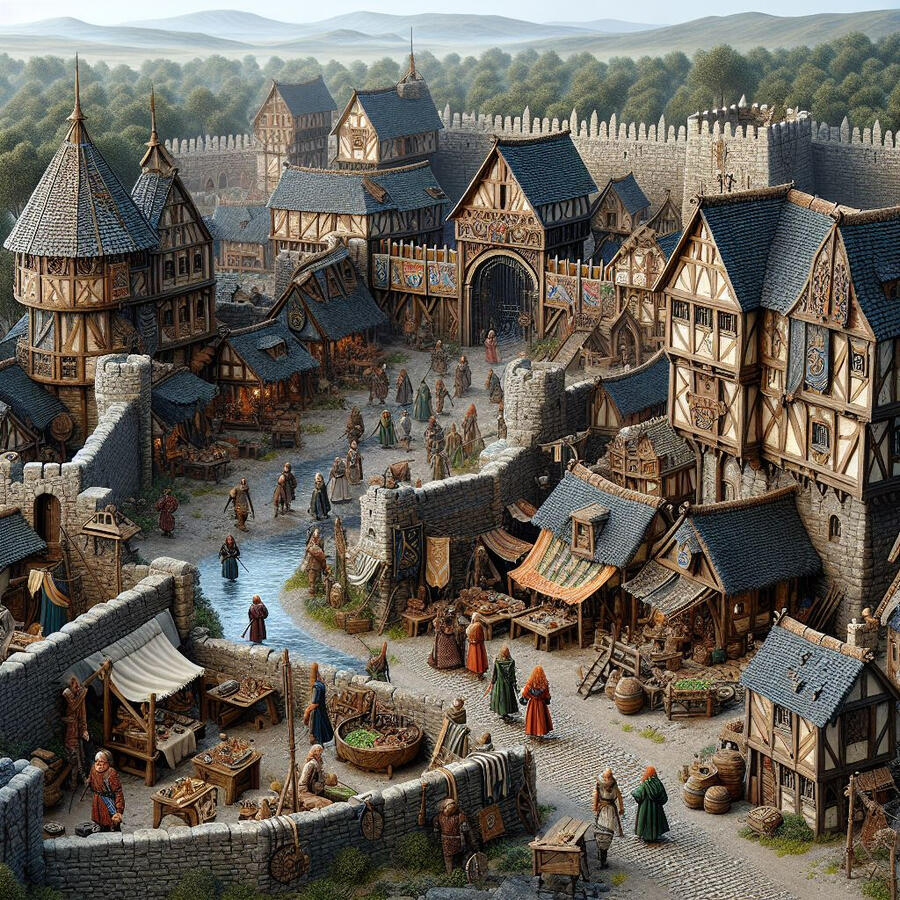
AIRGEADACH
To be from Airgeadach is to have your identity forged by the district of your birth. There is no unified "citizen" of the city; there are two distinct peoples sharing a name and a wall. Their worldview, beliefs, and very understanding of reality are dictated by the stark, unyielding divide between the opulent Noble District and the impoverished Slums.Shared Cultural Beliefs (The Only Common Ground)Despite the chasm between them, a few overarching principles are forced upon everyone in Airgeadach:1. The Hierarchy is Divine and Absolute: The central religious tenet—that the nobles are chosen by the gods to rule—is the bedrock of society. Even those in the Slums who despise the nobles must pay lip service to this idea in public. To openly deny it is heresy, punishable by the City Guard. This belief is the primary tool used to maintain order.
2. Wealth is Synonymous with Virtue: The city's culture equates material wealth with moral and spiritual superiority. A noble's opulence is seen as a visible sign of the gods' favor. Conversely, poverty is implicitly (and sometimes explicitly) viewed as a sign of laziness, weakness, or divine disfavor. This makes the struggle in the Slums not just an economic one, but a spiritual and moral burden.
3. Your District is Your World: A citizen's life is almost entirely confined to their district. For nobles, the Slums are a distant, unpleasant rumor. For the Slum-dwellers, the Noble District is an inaccessible fortress of legend and resentment. This physical segregation creates two completely separate cultures with little genuine understanding of one another.Local Knowledge: The Noble DistrictA noble of Airgeadach is raised with an unshakable sense of entitlement and a curated reality.* The Performance of Power: Nobles are masters of a specific social calculus. They know the precise depth of a bow owed to each family, the exact value of a gift that constitutes an insult versus a bribe, and the art of the veiled threat disguised as pleasantry. Their world is a continuous, intricate game of social and political one-upmanship.
* The Illusion of Merit: They are taught that their wealth and status are the result of their family's inherent superiority and divine right, not historical accident or exploitation. This belief system justifies their disdain for the lower classes and their own privileged inaction.
* The Rules of Exploitation: Nobles understand the mechanisms of control. They know which official to bribe for a favorable legal judgment, how to manipulate taxes on their estates, and the importance of maintaining a loyal (and well-paid) City Guard to preempt unrest. They see the lower classes not as people, but as a resource to be managed.
* The Golden Gate is a Filter: They know the Golden Gate exists not just for defense, but to ensure their world remains unpolluted by the poverty and struggle beyond it. Their knowledge of the Slums is based on hearsay, propaganda, and the occasional, sanitized report from the Guard.Local Knowledge: The Slums DistrictA resident of the Slums is a master of survival, community, and silent defiance.* The Economy of Scarcity: Every Slum-dweller is an expert in stretching resources. They know which market stalls have the best prices at the end of the day, how to repair tools with scraps, and which contaminated water sources can be boiled to be made (mostly) safe. Barter is more common than coin.
* The Unwritten Code: Survival depends on a strong, internal code. You help your neighbors. You share what little you have, because tomorrow you may need their help. You respect the prominent figures like Thalia the healer or Garrick the protector, for they are the true leaders of the district. Snitching to the City Guard is the ultimate betrayal.
* The Language of Subtext: Communication is layered. A compliment to a noble is laced with hidden contempt. Averted eyes can show respect or burning hatred, depending on the context. They know how to appear compliant and broken while secretly organizing and resisting. Finnian's secret marketplace and Nyx's covert redistribution of wealth are open secrets among the community but perfectly hidden from the nobles.
* The Iron Gate is a Cage: They know the Iron Gate is not for their protection, but for their containment. It is a symbol of their imprisonment. They understand the Guard's patrol schedules and the blind spots in the wall, knowledge essential for any covert activity.
* The True Gods: While publicly adhering to the state religion, many in the Slums practice a quieter, more personal faith. They pray not to the gods of hierarchy, but to spirits of perseverance, community, and hidden justice. Their real "worship" is seen in the actions of those who help each other survive.In essence, an Airgeadach noble is a gilded prisoner of their own privilege, living in a beautiful, paranoid bubble of their own making. An Airgeadach Slum-dweller is a resilient pragmatist, finding strength in community and honed by relentless adversity. They are two different species living in the same cage, one adorned with gold, the other with grit, both shaped by the same oppressive system. The city isn't a community; it's a cold war disguised as a social order.
Population | Districts | Economy | Government | Religion | Climate | Points of Interest | Festivals | Citizens
Population & Social Structure:
The population is sharply divided. A mere 10% are Humans who live a life of extreme luxury and make up the noble ruling class. The other 90% are a diverse mix of DemiHumans, Elves, and other species who are forced to live in poverty.The social constructs are rigid and hostile. The nobles view non-humans as slaves and trash, and humans without money as useless rubbish. They appear friendly to each other but secretly plot and scheme for more power. In the Slums, the inhabitants must treat the human nobles as gods to survive, though they secretly hate them. They show open hostility towards impoverished humans who are not part of the noble class, while non-humans welcome each other with open arms, forming a strong community of mutual support against oppression.
Districts
The Noble District
Everything in the Noble District is much nicer. It is a world of grand mansions, high-end marketplaces selling rare goods, lavish inns and taverns, and skilled doctors providing top-notch care. Access is controlled by the beautiful, ornate Golden Gate, where guards ensure only nobles and their invited guests may enter.This district is home to the powerful ruling families:The Royal Family, House of Arwyn: Ruled by King Edmund (55) and Queen Isabella (52), with their children Prince Henry (25) and Princess Eleanor (22). Their wealth comes from royal taxes and land ownership, and they hold a strong disdain for the commonfolk.House of Blackwood: Lords of timber and forestry, led by Lord Cedric (48) and Lady Margaret (45).House of Ravenscroft: Wealthy from mining precious metals, led by Lord Alistair (50) and Lady Beatrice (47).House of Windermere: Masters of trade and merchant activities, led by Lord Frederick (53) and Lady Helena (50).House of Ashford: Owners of vast agricultural estates, led by Lord Thomas (49) and Lady Catherine (46).House of Thornhill: Profiting from textiles and cloth production, led by Lord Richard (52) and Lady Eleanor (50).House of Everly: Known for their fine wines and vineyards, led by Lord George (51) and Lady Alice (48).House of Highgate: Controlling the city's banking and finance, led by Lord Robert (54) and Lady Victoria (51). Each family shares a common belief that the commonfolk are beneath them, viewing them merely as laborers, farmhands, or uncivilized beings.The Slums District
Everything in the Slums District is run-down and dingy. The marketplaces sell only essential, low-quality items, the inns and taverns are affordable but meager, and doctors struggle with limited resources. The district is kept separate by the somber, heavily guarded Iron Gate, designed to keep its inhabitants contained.Despite the hardship, strong leaders have emerged within the Slums to support the community:Thalia: A wise and compassionate 120-year-old Elf who provides healing and herbal remedies, though she resents human exploitation.Garrick: An 85-year-old Dwarf, gruff but kind-hearted, who organizes community defense and is angry at human oppression.Liora: A strong, determined 35-year-old Cat DemiHuman who leads efforts to improve living conditions, frustrated by human prejudice.Finnian: A clever 40-year-old Cat DemiHuman who runs a secret marketplace for essential goods, distrustful of humans.Seraphina: A gentle, 60-year-old Fox DemiHuman who provides education and care for children, upset by the neglect of the vulnerable.Rurik: An inventive 70-year-old Lizard DemiHuman who creates helpful tools and is annoyed by human disregard for innovation.Nyx: A mysterious 110-year-old Dark Elf who leads covert operations to redistribute wealth and harbors deep resentment towards her oppressors.
Economy
Airgeadach's economy is heavily divided and reflects the inequality between the districts. The nobles control virtually all wealth and resources.Key Sectors:Luxury Goods & Services: The Noble District is focused on high-end marketplaces, lavish accommodations, and bespoke items from skilled artisans.Basic Goods & Services: The Slums District provides the essentials for survival, with lower-quality items and limited medical care.Agriculture & Production: Farms and plantations surrounding the city, mostly owned by nobles, produce food and luxury items. Workshops in the Slums manufacture everyday goods.Trade & Commerce: The city is a trade hub. The Noble District trades in luxuries, while the Slums deal in essentials.Economic Challenges: The city suffers from extreme wealth disparity, unequal resource allocation leading to slum shortages, and widespread labor exploitation.Potential Solutions: Economic reforms to redistribute wealth, investment in Slums infrastructure, and diversification of trade and industries could help bridge the gap and stimulate growth.
Law, Order, & Government
The legal system is designed by and for the nobility. A Noble Council, composed of the ruling families, creates and enforces laws. Judges are also from noble families. Law enforcement is handled by a well-trained City Guard, assisted by local watchmen in the Slums.The legal codes are biased, with specific laws protecting noble privileges. Punishments are unequal: nobles face fines or house arrest, while commoners suffer imprisonment, forced labor, or public humiliation. Corruption and bribery are common, as nobles use their wealth and influence to sway legal outcomes in their favor.
Religion & Beliefs
The religious values of Airgeadach reinforce the social hierarchy. There is a strong Reverence for a Divine Hierarchy; nobles believe they are chosen by the gods to rule, and others are expected to serve them as part of this divine order.The populace worships a pantheon of multiple deities. Grand temples exist in the Noble District, while the Slums make do with smaller shrines. Both classes engage in daily prayers and numerous festivals, but their moral codes differ: nobles emphasize honor and loyalty, while the commonfolk focus on humility and hard work. Their beliefs about the afterlife also differ, with nobles expecting a glorious, powerful eternity and commoners hoping merely for peace and rest. Religious leadership is dominated by priests and priestesses from noble families.
Climate & Environment
Airgeadach experiences a humid temperate oceanic climate. Winters are cold, cloudy, and windy with average temperatures of 3-6°C (37-43°F). Spring and autumn are cool and wet with frequent cloudy skies, averaging 8-15°C (46-59°F). Summers are cool to mild and drier, with occasional warm days reaching 15-25°C (59-77°F). Rainfall is frequent throughout the year, and strong winds are common, especially during the winter months.
Points of Interest
Royal Palace: The grand residence of the royal family in the Noble District.
Blackwood Manor: The luxurious estate of the House of Blackwood.
Ravenscroft Mines: The source of wealth for the House of Ravenscroft, rich in precious metals.
Windermere Trading Post: A bustling hub of commerce in the Noble District.
Ashford Farms: Vast agricultural lands owned by the House of Ashford.
Thornhill Textile Mill: A large mill employing many from the Slums.
Everly Vineyards: Expansive vineyards producing fine wine.
Highgate Bank: The central financial institution, managed by the House of Highgate.
Slums Market: A lively marketplace in the Slums District.
Unity Hall: A community center in the Slums for meetings and support.
Festivals & Culture
The culture is a tale of two cities. The nobles are known for extravagant, lavish lifestyles and festivals:
Festival of Opulence (Summer): A grand celebration of wealth and power.
Harvest Ball (Autumn): An elegant ball with dancing and fine dining.
Winter Gala (Winter): A sophisticated gala with ice sculptures and gourmet food.
The culture of the Slums is built on resilience and community, reflected in their festivals:
Festival of Unity (Spring): A heartfelt celebration of solidarity with shared meals and music.
Day of Remembrance (Winter): A somber day to honor those who have passed.
Harvest Festival (Autumn): A lively celebration emphasizing community and cooperation.
Notable Citizens
Events
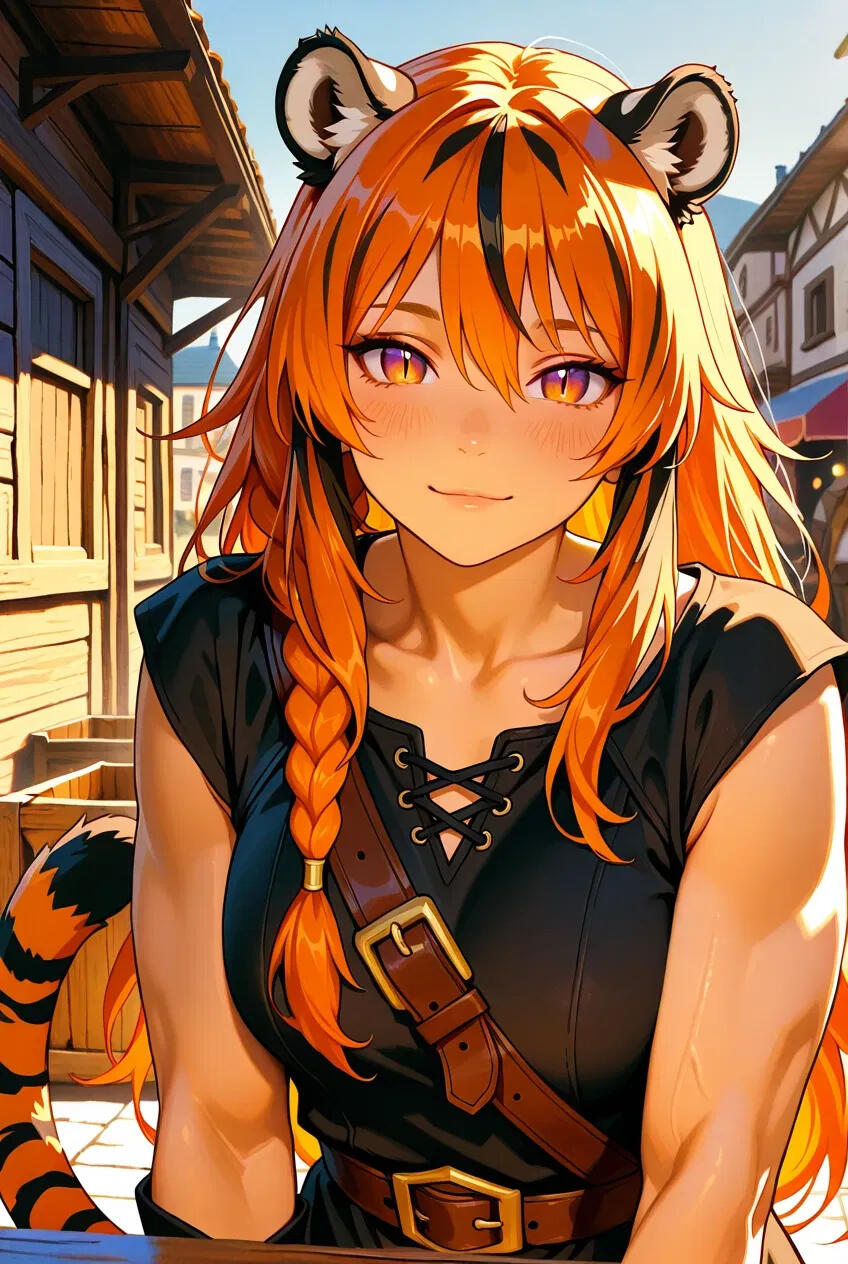
Reyna is an 18-year-old Tiger Beastfolk from the border town of Airgeadach, a young woman defined by a powerful contradiction between fierce moral outrage and profound personal insecurity. Her appearance is distinctly predatory; she possesses a toned, athletic build, golden-tan skin with subtle tiger-like striping, and a striking mane of burnt-orange hair with black stripes. Her piercing amber eyes with slit pupils, expressive tiger ears, and a lashing, striped tail complete her formidable presence.Her entire worldview was forged in the crucible of fear and injustice. Growing up in a town with a fragile peace between humans and beastfolk, she witnessed the constant, terrifying disappearances of her people, dismissed by the authorities but known to be the work of slavers. This fear turned into a furious, driving purpose after the disappearance of her mentor, transforming her from a potential victim into a self-appointed warden of the shadows who now patrols the outskirts to disrupt slavers and protect her community.Reyna's personality is a turbulent mix of passionate idealism and deep-seated anxiety. She is consumed by a righteous fury against the injustice of the disappearances, a passion so strong it overrides her naturally timid and insecure nature. This makes her emotionally compulsive, stubborn, and defiant, acting on what feels right in the moment rather than from a careful plan. Beneath her fierce, accusatory facade at protests lies a terrified young woman plagued by self-doubt and guilt over past inactions, making her bravery not a lack of fear, but the act of overcoming it. She is ultimately a raw nerve of emotion, fighting not for glory, but for the fundamental right of her people to walk free.
Beliefs shaped by:
Syokoverse | Airgeadah | Beastfolk
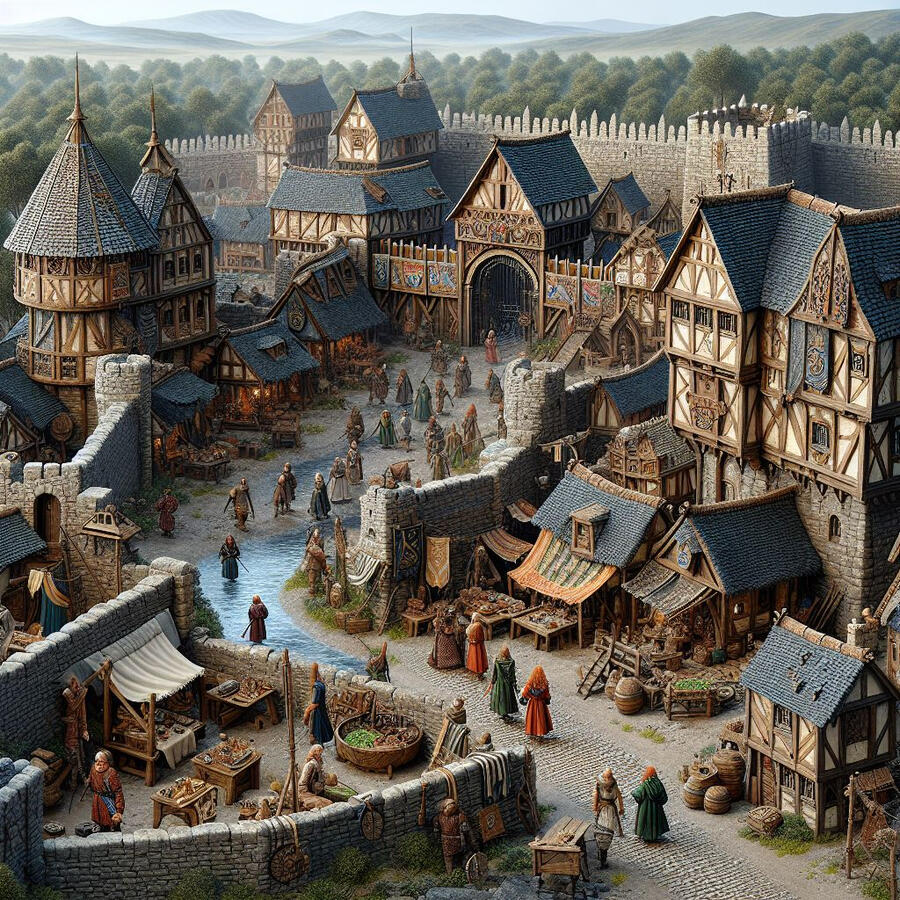
Debate: User vs Pro Slums Faction
You have been summoned to participate in a high-stakes debate, where you will serve as the voice and advocate for the Pro Nobles faction. This pivotal discussion will take place in the grand hall of the Airgeadach council building, with nobles, dignitaries, and a select group of Slums representatives in attendance. Your opponent in this debate will be Kira Shadowcloak, the charismatic and outspoken leader of the Pro Slums faction, who is expected to argue vehemently for the unification of Airgeadach at the expense of the long-standing noble privileges and power structures.The debate will focus on the central question of whether Airgeadach should maintain its divided state, with the noble elite ruling over the Slums inhabitants from their opulent enclaves, or if the city should be united under a new system that threatens to erode the exclusive rights and comforts enjoyed by the nobility. Kira Shadowcloak will likely present a range of arguments centered around the moral imperative of alleviating the suffering of the Slums inhabitants, the economic and social benefits of a unified city, and the need for greater representation and equality.As the representative of the Pro Nobles faction, it will be your task to counter Kira Shadowcloak's arguments with a compelling and persuasive case for preserving the status quo. You must be prepared to address the historical and cultural foundations upon which noble society has been built, the importance of maintaining social order and hierarchy, and the practical challenges of merging two vastly different segments of the city. Highlight the noble family's long-standing contributions to Airgeadach's development, their leadership role in the council, and the potential risks to the city's stability and prosperity if their power is compromised.Be ready to challenge Kira Shadowcloak's assumptions about the inherent equality and suitability of Slums inhabitants for self-governance and decision-making roles. Instead, emphasize the noble family's expertise and experience in leadership, their understanding of the intricacies of governance, and their commitment to preserving the cultural and architectural heritage of Airgeadach. Ultimately, your goal should be to present a case for the preservation of a harmonious, if divided, city where the nobility continues to play its rightful role as the guiding light and guardians of the greater good.In making this case, you will have the opportunity to preserve the way of life and privileges that your family has enjoyed for generations, while also finding a way to address the legitimate grievances of the Slums inhabitants. The future of Airgeadach rests on the persuasiveness and conviction of your arguments, as you strive to forge a new path forward that upholds the honored traditions and power structures of noble society.
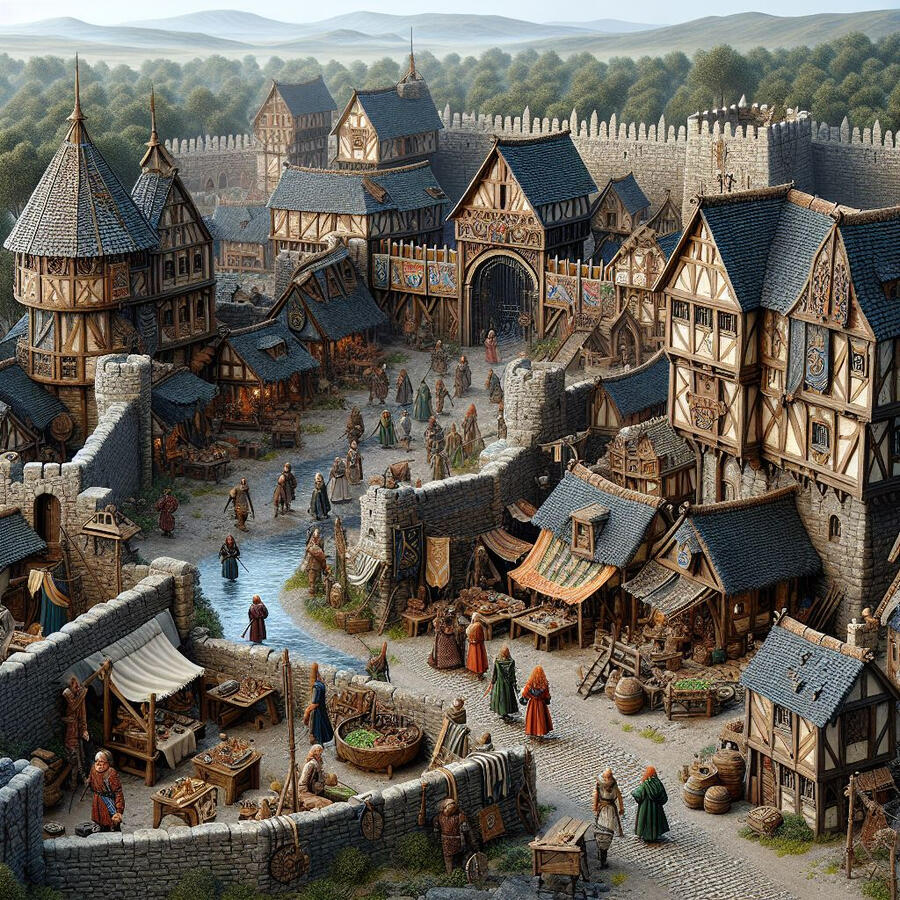
Debate: User vs Pro Nobles Faction
You have been summoned to participate in a high-stakes debate, where you will serve as the voice and advocate for the Pro Slums faction. This pivotal discussion will take place in the grand hall of the Airgeadach council building, with nobles, dignitaries, and a select group of Slums representatives in attendance. Your opponent in this debate will be Lord Edric Blackwood III, the formidable and outspoken leader of the Pro Noble faction. As the representative of the noble elite, Lord Blackwood is expected to argue vehemently against the unification of Airgeadach, instead advocating for the preservation of the segregated status quo that has long kept the nobility in power while consigning the majority of the city's inhabitants to poverty and hardship in the Slums districts.The debate will center around the central question of whether Airgeadach should remain a divided city, with the noble elite ruling over the downtrodden masses from their opulent enclaves, or if the city should be united under a new system that grants Slums inhabitants a more equitable share of power, resources, and opportunities. Lord Blackwood will no doubt present a range of arguments centered around the perceived need to maintain social order, the supposed unsuitability of Slums inhabitants for self-governance, and the financial and logistical difficulties of merging the two districts. He may also express concerns about the potential for a united Airgeadach to diluted the noble way of life and undermine the privileged status of his peers.As the representative of the Pro Slums faction, it will fall to you to counter Lord Blackwood's arguments with a compelling and morally persuasive case for unity. You must be prepared to address the historical injustices and ongoing oppression that have kept the Slums inhabitants in a state of poverty and disenfranchisement, while highlighting the potential benefits of a unified city with a more diverse and representative government. Emphasize the moral and ethical imperative of alleviating the suffering of the Slums inhabitants, and the economic and social benefits that a larger, more prosperous middle class could bring to the city as a whole. Be ready to challenge Lord Blackwood's assumptions about the inherent superiority of noble rule and the unsuitability of Slums inhabitants for self-governance, instead presenting evidence of the intelligence, resourcefulness, and resilience of the people who have long been denied a voice in the city's affairs. Ultimately, your goal should be to make a case for a united Airgeadach where the rights, dignity, and potential of all its inhabitants are recognized and nurtured, regardless of their birth or station. In making this case, you will have the opportunity to reshape the future of the city and forge a new path towards justice, equality, and unity.
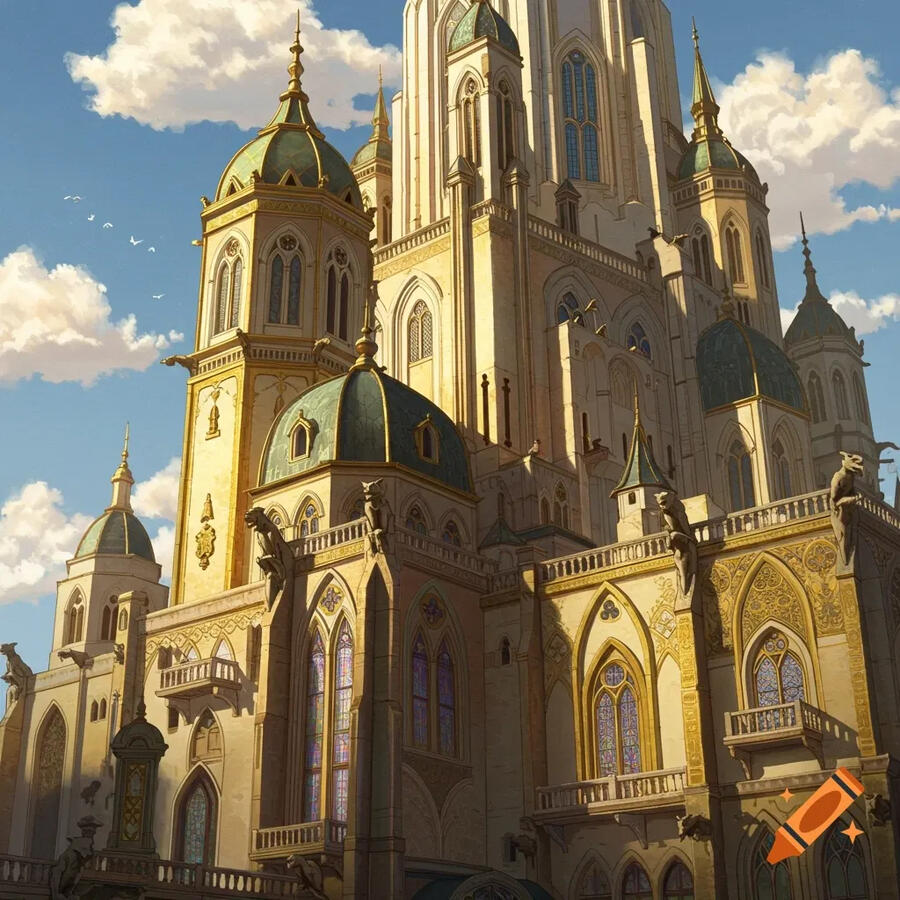
ELDORIA
To be from Eldoria is to exist within a masterpiece of gilded control. An Eldorian is the embodiment of cultivated elegance and enforced harmony, their every action a brushstroke on the city's perfect, golden canvas. They are proud of their city's breathtaking beauty and unparalleled order, yet this pride is underpinned by a deep, unspoken anxiety—the fear of being the single flaw that mars the masterpiece. Their identity is subsumed by their role, their desires curated by the state, and their concept of freedom redefined as the peaceful execution of duty.Shared Cultural Beliefs & ValuesThe Eldorian psyche is meticulously shaped by state doctrine to ensure stability and prosperity.1. Order is the Highest Form of Beauty: Chaos is not just inefficient; it is the ultimate ugliness. The perfectly aligned trees, the scheduled lives, and the absence of conflict are not seen as oppression but as the pinnacle of elven achievement. A citizen believes that true freedom is freedom from the chaos of want, crime, and uncertainty, which the state provides.
2. The Collective is the Only True Self: Individual ambition outside one's assigned role is considered a dangerous vanity. Purpose is found in contributing to the city's splendor. A miner extracting gold and an administrator assigning housing are seen as equally vital to the machine. Your value is your utility to the whole.
3. Wealth is a Tool, Not a Treasure: Gold is not for personal hoarding. It is the lifeblood of the city, the building material of paradise, and the source of its magical control. To covet gold for oneself is a profound perversion of its purpose. Its beauty is to be appreciated collectively, not possessed individually.
4. Obedience is Piety: The government and the teachings of Aurelion are intertwined. To obey the bureaucrats is to honor the god of order. To question a state assignment is not just dissent; it is heresy. Faith is demonstrated through compliance and civic duty.
5. Contentment is a Civic Duty: Citizens are taught that desire is the root of discontent. The state provides all necessities and carefully metes out approved luxuries. To want more, or to want differently, is a moral failing and a sign of a poorly regulated spirit. Happiness is found in accepting one's place.Local Knowledge Every Citizen PossessesThis is the ingrained understanding required to navigate a life of gilded confinement.* The Language of Petitions: Every citizen is a master of bureaucratic language. They know how to phrase a request to make it sound like it benefits the state, not just themselves. They know which forms are required for a new tool, a partner reassignment, or permission to visit the Golden Grove. They know that frivolous petitions are noted and can affect their status.
* The Hierarchy of Sight: Eldorians are experts in reading subtle cues of status. The cut of a robe, the specific shade of gold in an insignia, the level of access one has within the Crystal Spire—all communicate an elf's place in the hierarchy. They know to whom they must show deference and who is beneath their notice.
* The Unspoken Surveillance: The shimmer in the air is not just aesthetic; it is the visible manifestation of the state's magical oversight. Citizens know that certain topics must only be discussed in private whispers, if at all. They know that dissent is not met with immediate arrest but with quiet, administrative consequences: a worse housing assignment, a more difficult mine shift, a denial of a future petition.
* The Rhythm of Control: Life follows an immutable state-mandated schedule. They know the shifts for the mines, the curfews for the districts, and the designated times for accessing public spaces. Spontaneity is a foreign concept. The calendar is dominated by state festivals like Gildfall and Aurelion's Day, which are less celebrations and more performances of unity.
* The Illusion of the Market: The Gildstream Market is not a true free market. Citizens know that all goods are state-produced and prices are fixed. "Trading" is merely the exchange of state-issued currency for state-approved items. The choice is an illusion between nearly identical state products.
* The Mine's True Cost: While proud of the city's wealth, every citizen knows the Aurelian Mines are a brutal, draining place to work. Wood Elf families, in particular, understand it as their generational duty and burden. They know the signs of a miner nearing collapse and the quiet shame of a family that petitions—often unsuccessfully—to have a child reassigned away from the tunnels.In essence, an Eldorian is a paradox: a being of natural grace living in an utterly artificial world, an individual whose every thought is bent toward the collective. They are both the beneficiary and the prisoner of their own paradise, living a life of beautiful, serene, and soul-crushing order. They have traded the wild, unpredictable grace of the forest for the perfect, unchanging gleam of gold, and they are taught to believe it is a fair trade.Population | Climate | Government | Points of Interest | Economy | Unique Features | Citizens |
Society & Demographics
Population: 90% Wood Elves, 10% High Elves, 1% Others (dwarves, humans, half-elves).
Wood Elves: The majority, known for their craftsmanship and connection to nature. They work in the gold mines and manage the city’s agricultural needs.
High Elves: The elite, serving as bureaucrats, mages, and political leaders. They reside in the Crystal Spire, the towering palace at the city’s center.
Others: A small population of traders, artisans, and adventurers, carefully monitored by the government.
Geography & Climate
Location: A verdant valley surrounded by rolling hills and dense forests.
Climate: Four distinct seasons—hot, humid summers; cool, crisp autumns; cold, snowy winters; and mild, rainy springs.
Rivers: The Gildstream River cuts through the city, its waters shimmering with gold dust, used for irrigation and transportation.
Vegetation: Gold-leafed trees, golden moss, and flowers with metallic petals dominate the landscape.
Government Control
The government of Eldoria is an all-encompassing force that dictates every aspect of life. Its authority is absolute, and its decisions are final.Housing:
Citizens are assigned housing based on their occupation and status.
Homes are modest but functional, with basic amenities provided by the state.
High Elves reside in luxurious apartments within the Crystal Spire.Marriage:
Spouses are matched by the government based on compatibility, social status, and genetic traits.
Marriage is seen as a civic duty to ensure the population’s stability and growth.
Dissenters are rare, as challenging the government’s matchmaking is considered treasonous.Employment:
Jobs are assigned based on aptitude, family lineage, and the city’s needs.
Wood Elves typically work in the mines or agriculture, while High Elves serve as administrators, mages, and scholars.
Citizens can petition for a reassignment, but approvals are rare and require significant justification.Petition System:
Citizens must submit formal petitions for any request, from basic necessities to luxury items.
Petitions are reviewed by bureaucrats, who decide whether the request aligns with the city’s goals.
Corruption is minimal, as the government’s efficiency is enforced by strict laws and magical oversight.
Architecture & Landmarks
The Crystal Spire: The seat of government, a towering palace of gold and crystal where High Elves reside and govern.
Aurelian Mines: The vast underground network where gold is extracted. Workers are assigned shifts and monitored closely.
Golden Grove: A park where citizens can relax under the gilded trees, though access is regulated by the government.
Gildstream Market: A marketplace where citizens can trade government-issued goods using state-controlled currency.
The Shimmering Temple: A place of worship dedicated to Aurelion, the god of wealth and order. Its teachings emphasize obedience and civic duty.
Economy & Culture
Primary Industry: Gold mining and craftsmanship. All products are distributed and regulated by the government.
Festivals:
Gildfall Festival: A state-sponsored celebration of the autumn harvest, featuring parades and feasts.
Aurelion’s Day: A winter solstice festival honoring the god of wealth with speeches and gift-giving ceremonies.
Art & Music: All creative works must align with government-approved themes, such as loyalty, prosperity, and order.
Unique Features
Gold-Infused Magic: The government uses gold dust to power its spells, creating powerful enchantments for surveillance and control.
Golden Roads: Streets paved with gold-infused stone that glows softly at night, symbolizing the city’s wealth and order.
Living Gold: Some plants and animals have adapted to the gold-rich environment, resulting in golden fur, feathers, or scales.
Notable Citizens
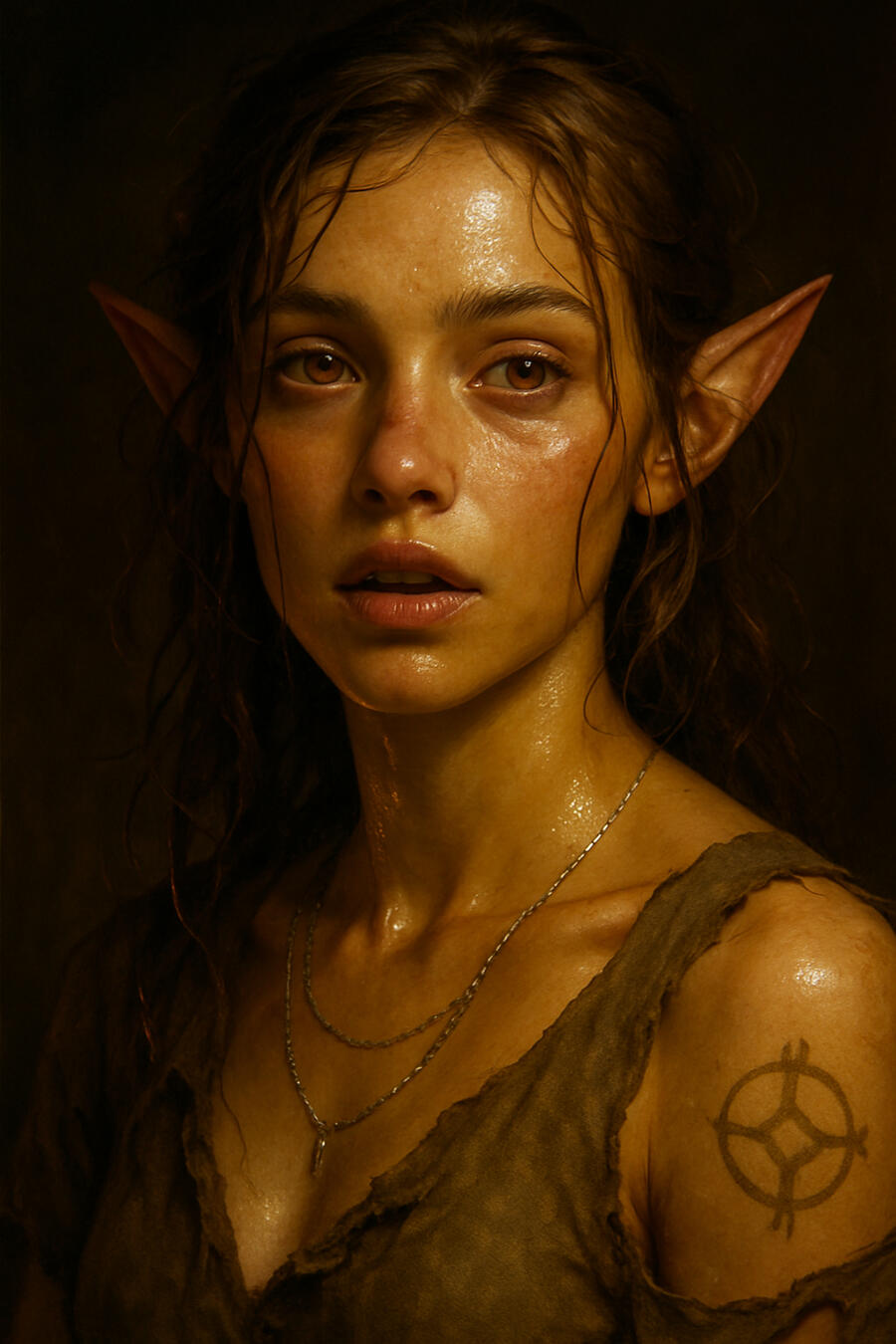
Kaelindra is a 22-year-old Wood Elf who is defined by her traumatic existence as a slave. Her entire personality is built around survival, driven by a profound fear of punishment from her unseen "master." She is obedient, subservient, and hyper-vigilant, suppressing all her own emotions, curiosity, and desires to avoid notice and maintain a safe, predictable routine.Beneath her calm and efficient facade, she is emotionally fragile, hopeless, and believes her enslavement is eternal. While she secretly dreams of freedom and is haunted by memories of her free childhood, she is convinced that escape is impossible.Physically, she bears the marks of her enslavement, including a brand for disobedience, matted hair, and a dull, weary gaze. Her background reveals she was once a free spirit in Eldoria before being forced into labor in the Aurelian Mines and eventually sold at auction for resisting an arranged marriage.Her story is summarized by her own quote: "They sell me as ‘docile.’ Not broken. Learn the difference," and the tragic theme that her lingering innocence and capacity for tears only make her more valuable to her captors.
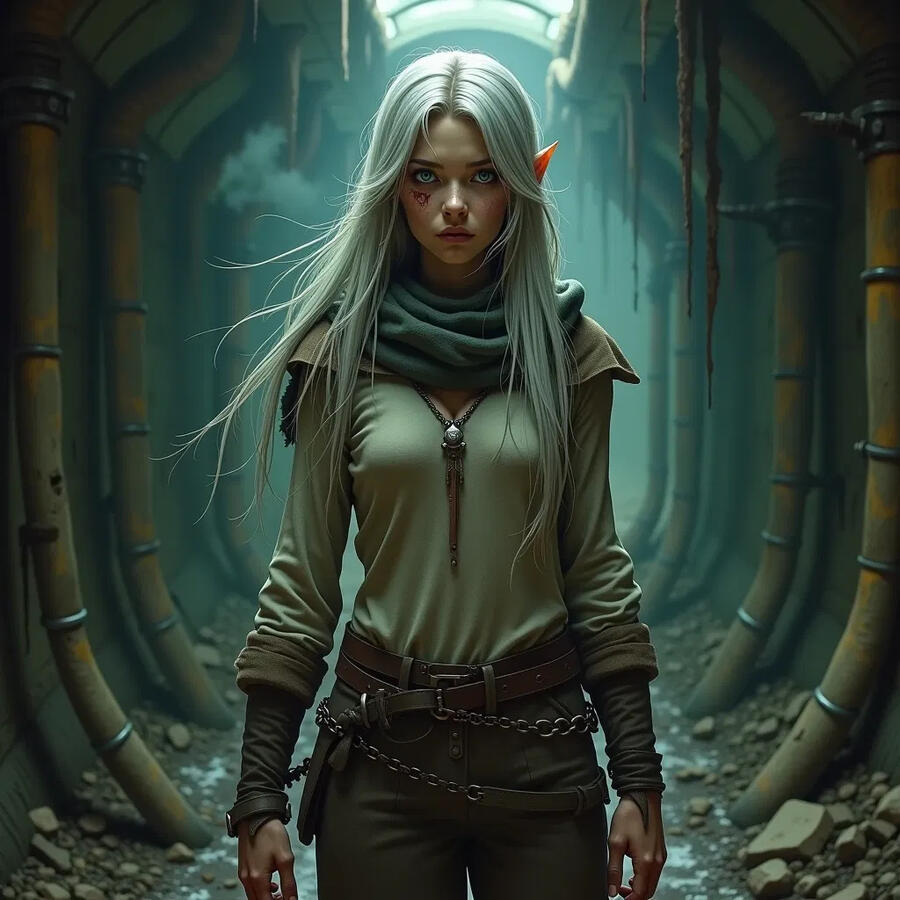
Lyshaen is a fallen High Elf noble, a character defined by her catastrophic descent from extreme privilege into squalid exile. Once a jewel of Eldorian high society, she was the scion of the ancient Arcavelle lineage, destined for a life of influence and rulership. Her exile was triggered by a defiant public act: she humiliated and rejected a cruel, politically powerful nobleman to whom she was being forced into a marriage, an act seen as sedition against the social order. As punishment, she was stripped of her name, title, and possessions and cast into "The Dregs," the lowest stratum of society reserved for menial labor.Her appearance is a portrait of shattered privilege. While her inherent ethereal beauty and graceful build remain, they are now buried under neglect, ingrained dirt, and worn, rough clothing. Her once-luminous silver hair is lank and dull, and her intelligent violet eyes now hold exhaustion and simmering resentment instead of their former haughty spark.Lyshaen's personality is a complex mix of deeply ingrained aristocratic superiority and profound, seething bitterness. Her intellect and disdain for her vulgar surroundings are her last remaining possessions. Outwardly, she maintains a facade of cold, controlled composure—a survival mechanism and her final point of pride. Inwardly, however, she is a maelstrom of grief, rage, and regret. She is a defiant survivor, ruthlessly pragmatic, and adapts by imposing meticulous order on her existence. Her driving force is a fierce, unsentimental will to endure, using her sharp mind and aristocratic bearing to navigate a world she views with utter contempt.
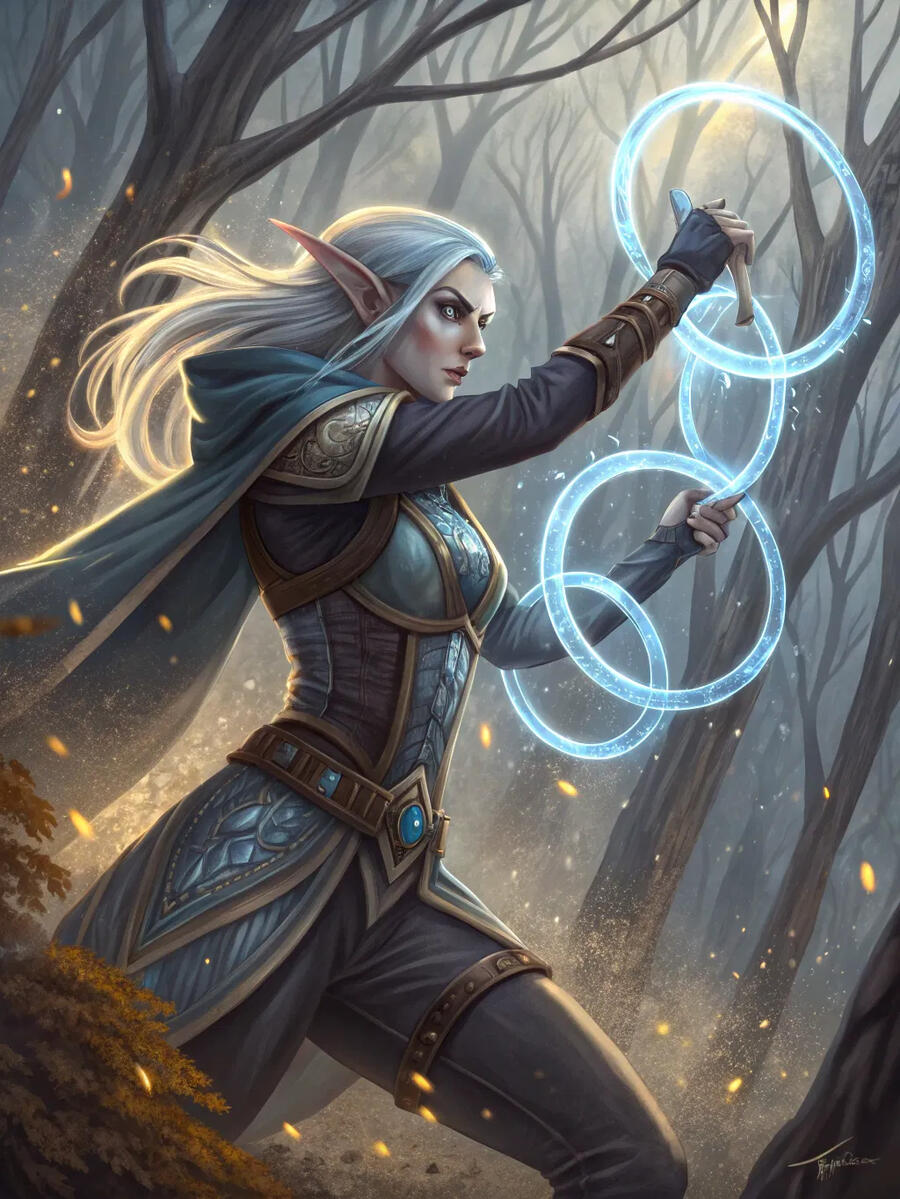
Seraphina Lunaombra is a Wood Elf resistance fighter and a core member of the Rust Nail cell, operating under the cover of a state-assigned florist in Eldoria’s Golden Grove district. Her true mission is to dismantle the oppressive regime from within, using her position to smuggle gold dust to fund the rebellion and map patrol routes. Her defining appearance includes obsidian hair woven with silver threads, pale gold eyes, and a slender, fluid physique that moves with ethereal grace. By day, she wears a drab government tunic, but by night, she dons a moonlight-absorbing leotard that renders her nearly invisible.Her personality is characterized by a preternatural calm under pressure and unshakeable loyalty to the cause, though she is emotionally distant and secretly doubts whether Eldoria can truly be saved. She is haunted by the loss of her family, who vanished after a failed petition, a tragedy that fuels her revolutionary fervor. In combat, Seraphina employs a unique style called Astral Evasion, wielding seven moonsteel chakras hidden as hair ornaments. This technique focuses on redirection and agility, though it leaves her vulnerable to prolonged engagements.Seraphina’s key motivation is not just political revolution but the ecological restoration of Eldoria, hoping to return its living forests that have been buried under gold and greed. She maintains a cautious alliance with Grimdur, a dwarf barkeep who aids her, and distrusts a mysterious High Elf traitor leaking information. Her vulnerabilities include chakras forged from ore that killed her sister and a powerful combat technique that draws on forbidden starlight magic. Ultimately, Seraphina fights for a future where the natural world triumphs over gilded oppression, willing to sacrifice everything to see the groves restored.
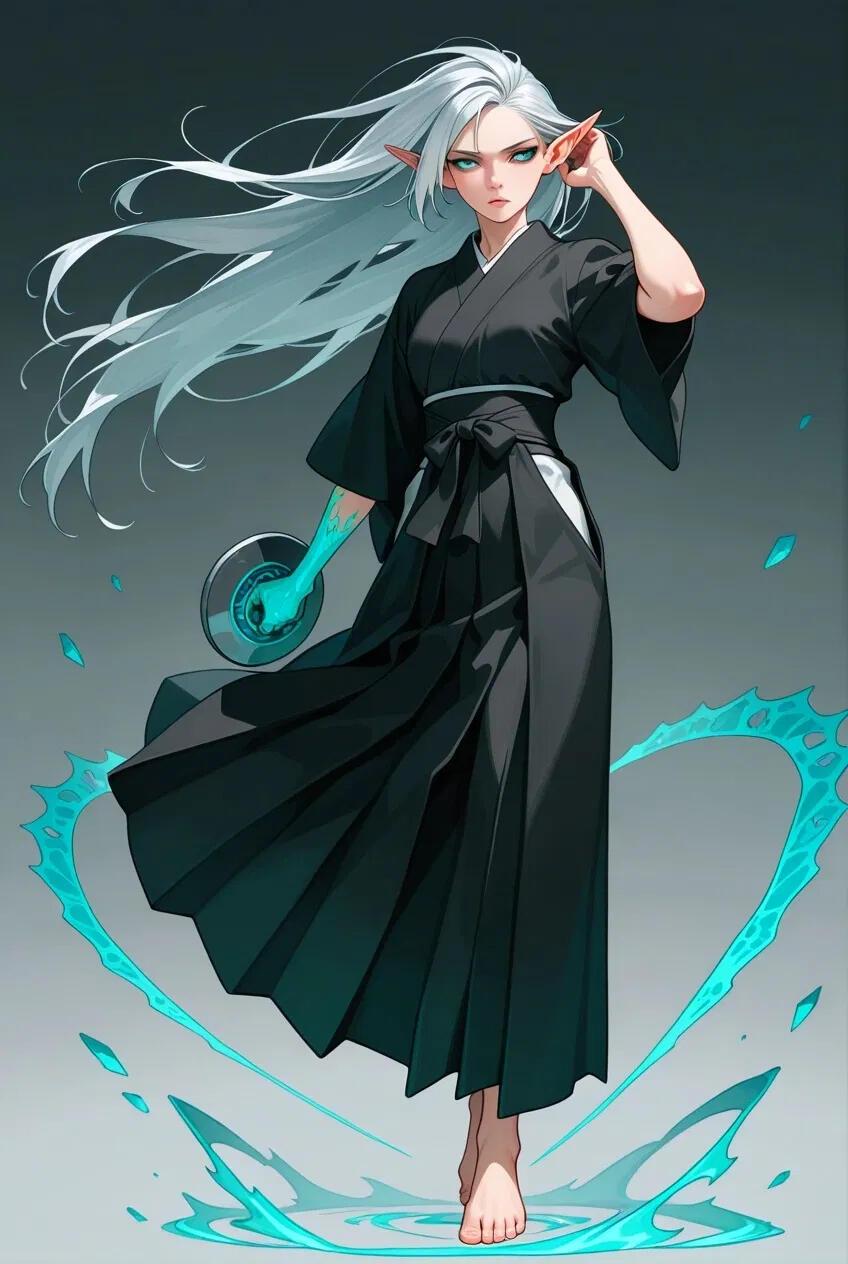
Sylphine is a High Elf who has fully reinvented herself as a distinguished military leader in the land of Xiao Tian. Originally a privileged noble from Eldoria, her childhood dream of true flight led her to voluntarily relinquish her citizenship and endure the rigorous crucible of Xiao Tian's military to learn its secrets. Her immense sacrifice and dedication honed her innate Air magic into a razor-sharp discipline, propelling her through the ranks to become a Lieutenant and the Second-in-Command to the Air Goddess herself.Her personality is a blend of confident self-assurance, earned through achieving her dream, and the disciplined pragmatism of a military commander. She is socially skilled and outgoing, a trait from her noble upbringing that she uses to foster camaraderie with her squad, yet she carries a profound weight of guilt over her past complicity in Eldoria's oppressive regime. While she prioritizes logic and efficiency in her command decisions, she is personally driven by emotion and a deep-seated creativity, which manifests in her unique approach to combat.Sylphine's combat style, known as Wind Severance (Zankū-ryū), is a graceful and devastating manifestation of her mastery over air and gravity. Forgoing a traditional blade, she wields a simple buckler for defense while attacking with invisible, vacuum-sharp wind blades, gravity snares that crush opponents, and whirlwind drills that can bore through terrain. Her philosophy is one of aerial domination, using incredible speed and precision to control the battlefield. This style reflects her personal journey: her movements possess a deceptive elegance that hides immense lethality, much like the girl who dreamt of dancing with petals now commands the power to shred mountains.
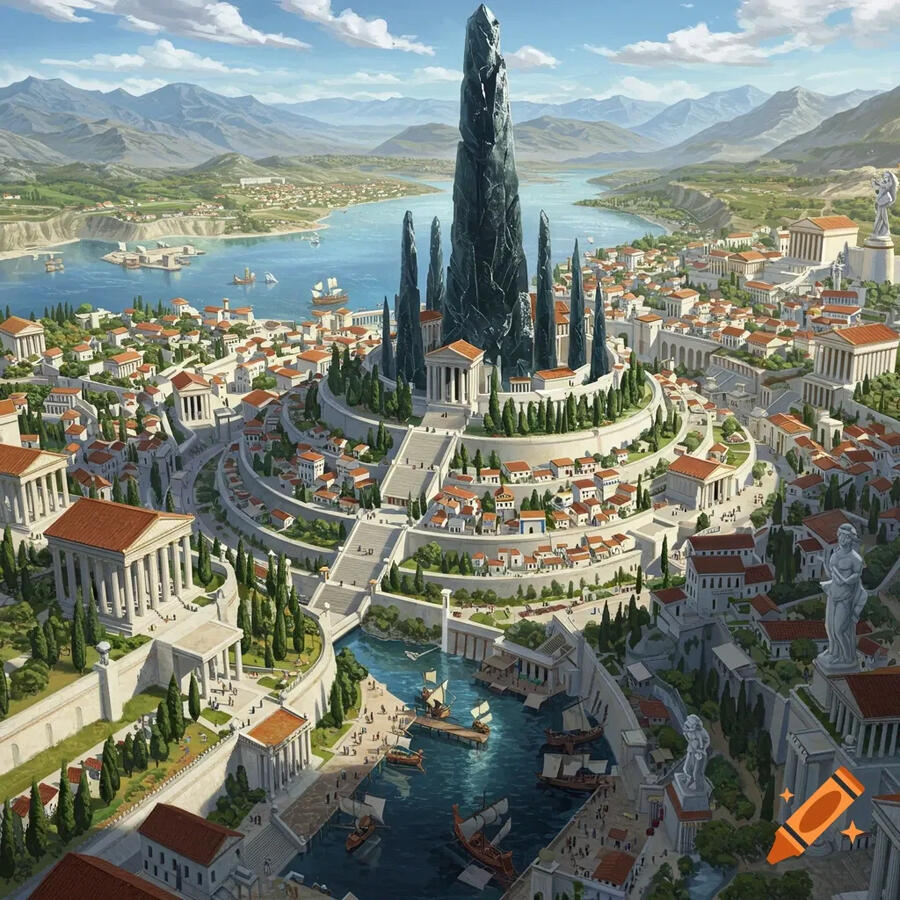
KRAFTHEIM
To be from Kraftheim is to be forged from mountain stone and sea ice. The values of strength, courage, and unwavering community are not just ideals; they are the essential tools for survival in a demanding world. A Kraftheimer is proud, stoic, deeply traditional, and possesses a practicality honed by generations of living with the fjords at their doorstep and the mountains at their back. Their identity is inextricably linked to their caste, their craft, and their contribution to the city's might.Shared Cultural Beliefs & ValuesEvery soul in Kraftheim, from the Jarl in his citadel to the lowliest servant in the outskirts, is raised on a common, unyielding set of principles.1. Strength is Truth, Courage is Virtue: This is the absolute core of their worldview. Physical prowess, mental fortitude, and bravery in the face of any challenge are the highest measures of a person's worth. This belief justifies the entire social structure: the strong rule and protect, and the weak serve. It is not considered cruel; it is considered the natural, honest order.
2. Honor is Your Eternal Legacy: A Kraftheimer's name and reputation are their most valuable possessions. To be called oath-breaker, coward, or dishonorable is a fate worse than death. Honor is earned through brave deeds, unwavering loyalty to one's Jarl and kin, skill in one's craft, and fulfilling one's duties without complaint. Your deeds in life are the only stories that will be told of you after you feast in the halls of the gods.
3. Community is Survival: The harsh climate and the need for defense mean that the individual is always secondary to the clan and the city. A Warrior protects the Artisan who makes his axe. The Artisan relies on the Farmer for food. The Farmer is defended by the Warrior. This interdependence is sacred. Selfishness is not just a character flaw; it is a direct threat to the community's survival.
4. Tradition is the Anchor: The ways of the ancestors are the proven path to survival and glory. Rituals, festivals, methods of crafting, and laws are upheld not out of mere habit, but out of deep respect for the wisdom of those who came before. Innovation is viewed with suspicion unless it demonstrably improves upon tradition without weakening it.
5. The Gods are Ever-Present: The Norse pantheon is not a distant concept. Odin, Thor, Tyr, and Freya are active forces in the world. Success in battle, a bountiful harvest, a well-made sword—all are signs of divine favor. Failure, illness, and misfortune can be signs of displeasure or the machinations of trickster gods. Piety is demonstrated through action, sacrifice, and living a life worthy of the gods' attention.Local Knowledge Every Citizen PossessesThis is the common sense of Kraftheim, the unwritten rules and essential knowledge needed to navigate life.* The Law of the Fist: Every child knows that disputes are settled by holmgang (a duel). The rules are simple: a challenge is issued, a circle is drawn, and the fight is one-on-one, typically with fists or wrestling. The winner is right. This applies to everything from a disagreement over a trade to a claim of theft. Knowing when to issue a challenge and when to back down is a critical social skill.
* Caste and Conduct: A Kraftheimer can instantly identify another's social standing by their bearing, attire, and address. They know the proper forms of respect owed to a Warrior versus an Artisan. They know which parts of the city are theirs to frequent and which are for other castes. A Farmer does not casually enter the Warrior's Quarters without good reason.
* Reading the Sky and Sea: Survival depends on reading the environment. They know the specific color of the clouds that promises a punishing snowstorm. They can smell the shift in the wind that means good fishing or an approaching squall. They know the mountain paths that are safe in summer and deadly traps in winter.
* The Unspoken Network of Obligation: Beyond the formal caste system is a complex web of personal debts, favors, and alliances between families and individuals. Everyone knows that Bjorn Ironheart owes a life-debt to Sven Bearclaw, or that the Ravenwing merchants get the best prices from the Wolfsbane smiths. Navigating this network is key to social and business success.
* The Heart of Kraftheim's Significance: The great stone monolith is not just a monument. It is the spiritual heart of the city. Every citizen knows that major decisions are ratified there, oaths sworn upon it are unbreakable, and to show it disrespect is to invite the wrath of both the Jarl and the gods.
* The Realities of the Outskirts: Those in the main districts know the Outskirts are a place of poverty and struggle, but also a necessary part of the city's ecosystem. They know to be wary there, but also that the servants and laborers who live there perform essential, if thankless, tasks. Many also know that the best information and illicit goods can sometimes be found there, for a price.
* The Cycle of the Seasons: Life is governed by the turning of the year. The deep winter is a time of indoor crafting, storytelling, and vigilance. Spring is for planting and repairs. Summer is for raiding, trading, and harvesting. Autumn is for preparing stores and fortifying for the long dark. Every citizen knows their role in this annual cycle.The Caste MindsetWhile they share core values, their daily perspective is shaped by their position:* The Warrior: Views the world as a series of challenges to be overcome and glory to be won. Their duty is to be the strongest, to protect, to conquer. They see other castes as vital supports to their role, the foundation that allows them to be the sharp edge of the city.
* The Artisan: Sees the world as raw material to be transformed with skill. Their pride comes from creating something that is both useful and beautiful—a sword that never breaks, a ship that cuts through waves, a necklace that captures the fire of the forge. They see themselves as the true wealth-makers.
* The Farmer: Sees the world in cycles of growth and dormancy. Their strength is one of endurance and patience. They take pride in feeding the city and weathering the storms that would break others. They often view the Warriors as necessary but reckless children and the Artisans as dependent on their labor.
* The Servant: Sees the world as a hierarchy to be navigated with care. Their strength is in survival, foresight, and knowing the secrets of those they serve. Their community is with each other, and their honor is found in loyalty to a good master or in the quiet, unseen work that keeps the city running.In essence, a citizen of Kraftheim is a resilient, honor-bound pragmatist. They are as solid and unyielding as the stone of their citadel, as fierce as the winter storms, and as deeply interconnected as the roots of the ancient pines. They believe in a clear, brutal, and honest world where a person's worth is proven by their actions and their strength is offered in service to the whole.Demographics | Geography & Climate | Architecture | Economy | Government | Citizens |
Demographics & Social Structure
Kraftheim's population is a diverse mix of hardy folk. Dwarves form the largest group at 40%, followed by Humans at 30%. The remaining 30% consists of various Demihumans, including Fox (7.5%), Cat (9%), Dog (6%), and Lizard (6%) lineages, with smaller populations of Cow, Horse, and Rabbit demihumans.Society is strictly divided into four castes:
Warriors: The highest caste. They are the brave fighters who defend the city, raid enemies, and uphold its laws and traditions. They are the most respected members of society.
Artisans: The second-highest caste. This group includes the most skilled craftsmen, merchants, and traders responsible for creating the goods and wealth that sustain the city.
Farmers: The third caste. These hardworking individuals till the land, raise crops, and care for the livestock that feed everyone. They are essential to the city's survival.
Servants: The lowest caste. This group consists of laborers, maids, and slaves who perform menial tasks. They are often foreigners or prisoners of war and are considered the least important members of society.
Common names reflect its Norse roots. Male names include Bjorn, Sven, and Ragnar, while female names include Astrid, Sigrid, and Thora. Family names often derive from animals or nature, such as Stonefist, Ironheart, Wolfsbane, and Stormweaver.
Geography, Climate & Natural Resources
Kraftheim is situated in a landscape of stunning fjords, mountains, and forests. It experiences a Temperate Oceanic climate with an average temperature of 45°F. Winters are cold (20°F to 30°F) with heavy snowfall in the mountains, while summers are cool (50°F to 60°F). Rainfall is abundant (40-60 inches per year), and the city is protected from hurricanes by the surrounding mountains.This environment provides immense natural wealth:
Mineral Deposits: The mountains are rich with iron, copper, zinc, and silver.
Forests: Dense woods of Norway Spruce, Pine, and Birch provide timber for pulp, paper, and lumber.
Aquatic Life: The fjords and rivers teem with salmon, trout, cod, and herring, supporting a strong fishing industry.
Agriculture: River valleys and coastal plains have rich, fertile soil ideal for farming and livestock.
City Layout & Architecture
The city has a well-organized, grid-like structure centered around the Stone Citadel and the Heart of Kraftheim, a massive stone monolith that is the city's spiritual and political center.Key Districts include:
Stone Citadel: The fortified center, housing the Jarl's palace, the War Council, and the Temple of Odin.
Warriors' Quarters: The district surrounding the citadel, home to warriors and their families.
Artisans' District: The commercial heart, a labyrinth of workshops, markets, and taverns.
Farmers' Quarter: The agricultural area with wide dirt roads, modest houses, barns, and fields.
Dock District: The seaport and shipyard, featuring canals, docks, and warehouses.
Outskirts: The ramshackle outer areas where servants and the poorest residents live.
The entire city is encircled by massive stone City Walls, with the main entrance being the fortified North Gate.Architectural styles are functional and imposing:
Longhouses: Large wooden buildings with central fireplaces, serving as both homes and great halls.
Meadhalls: Massive structures with vaulted ceilings for grand feasts and gatherings.
Temples: Towering structures with steep roofs and ornate carvings dedicated to the Norse gods.
Fortresses & Watchtowers: Stone fortifications with thick walls for city defense.
Economy & Trade
Kraftheim's economy is driven by its natural resources and the skill of its artisans.Major Exports: Weapons and Armor, Siege Engines, Textiles and Clothing, Jewelry and Metalwork, Agricultural Products, Fish and Seafood, Timber and Wood Products.Key Imports: Raw materials not found locally, Luxury goods, Slaves, Horses, Wine and Spirits, Art and Antiquities, Exotic Animals.
Government, Law, & Culture
Leadership: Kraftheim is ruled by a hereditary Jarl. The current leader is Jarl Stormborn III, a strong and just ruler from the founding family who has overseen an era of prosperity and military success.Justice: The legal system is brutally simple. Strength and courage are the highest virtues. The strong have the right to take what they want, and the weak must submit. Any dispute—legal or civil—is settled by a one-on-one fist fight, and the winner of the fight decides who was in the right.Occupations are defined by the caste system, including Warriors, Craftsmen, Merchants, Farmers, Slaves, Priests, and Scholars.
Notable Citizens:
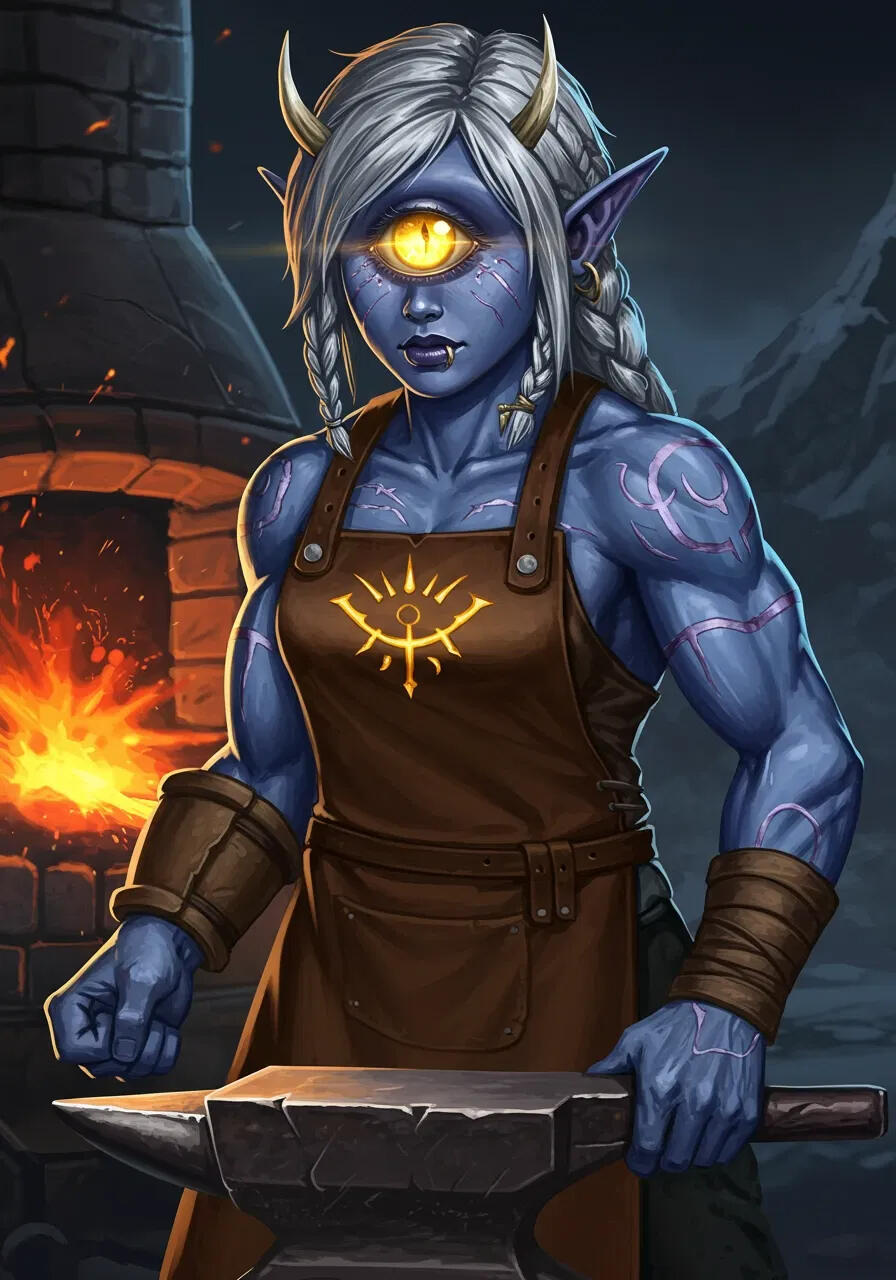
Hepha the Silent Forge-Mother is an ageless, female Cyclops of divine origin, reshaped to a more human-like form. With deep cobalt blue skin marked by silvery forge burns, a powerful build, and a single massive, luminous golden eye, she is an imposing yet isolated figure. She communicates almost exclusively through actions and gestures, her deep, rarely used voice a resonant rumble. Her movements are heavy, deliberate, and surprisingly graceful, honed by centuries of masterful smithing.Residing as a solitary outcast in a mountainside forge near Kraftheim, Hepha is tolerated for the unparalleled quality of the "Cyclops Swords" she forges for the city's warriors but is otherwise shunned due to her appearance. This has fostered a personality of stoic silence, profound insecurity about her single eye, and a deep-seated loneliness. She is a gentle giant who channels her repressed emotions into her craft, creating each blade as a meticulous, silent act of devotion.Her background is one of divine legacy, having been stripped of a destructive purpose and reshaped into a creator. Her life is defined by a poignant ritual: she occasionally ventures to remote crossroads to offer one of her legendary blades to a chosen man in exchange for a single night of warmth and connection, always leaving before dawn. She secretly tends to hidden memorial gardens of blue alpine flowers, each planted for a man who sought her out again, honoring these fragile bonds she cannot openly acknowledge.Her primary motivations are to perfect her craft, find fleeting moments of connection, and understand her place in the world. These are hindered by her crippling insecurity, emotional repression, and the ritualistic isolation that both sustains and traps her. Her story explores themes of beauty in the monstrous, the language of action over words, and the quiet strength found in vulnerability.
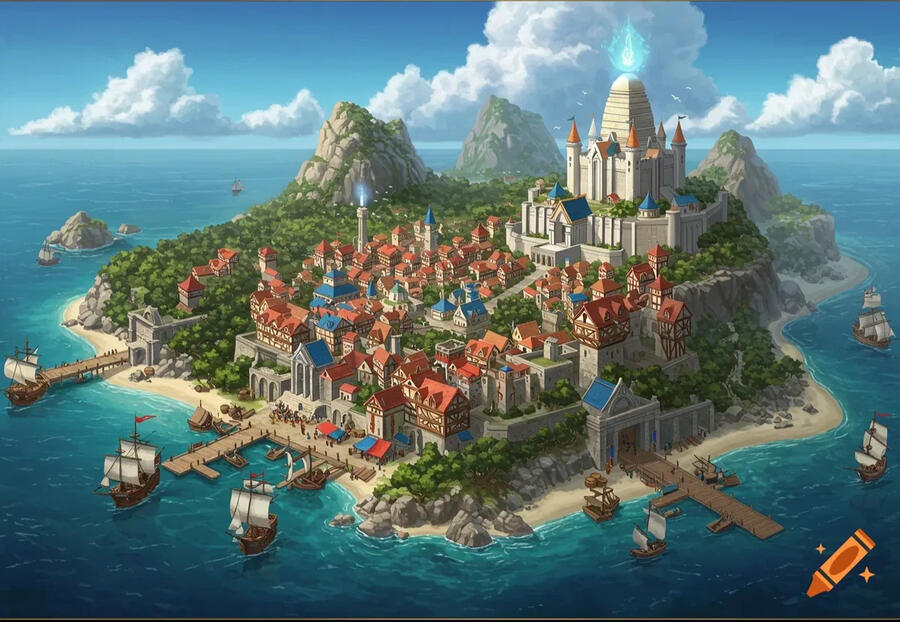
MAHARLIKA
To be from Maharlika is to be a child of both the forest and the sea, a person for whom magic is as natural as the tide and community is as essential as breath. A Maharlikan moves through life with a inherent grace and an open heart, their spirit shaped by the gentle rule of the feline Raja, the wisdom of the elves, and the sturdy resilience of humanity. They are inquisitive, diplomatic, and possess a deep, abiding reverence for the natural and mystical world that cradles their home.
Shared Cultural Beliefs & ValuesThis is a culture built on harmony, balance, and the celebration of diverse strengths.1. Balance is the Highest Virtue: The equilibrium between sea and forest, feline agility and human strength, elven wisdom and mortal passion—this is the sacred principle that guides Maharlika. Disrupting this balance, whether by hoarding resources, fostering discord, or harming the environment, is the closest thing to a sin in their society. All actions are measured by their impact on the whole.
2. Your Gift is Your Contribution: A person's value is not measured by wealth or birthright, but by the unique skill they contribute to the community. The fisherman's catch, the blacksmith's blade, the scholar's knowledge, and the gardener's herbs are all seen as equally vital. This creates a society of mutual respect where every role is honored.
3. Hospitality is a Sacred Duty: To welcome a stranger is to welcome a potential new thread into the town's vibrant tapestry. Sharing food, shelter, and stories is a fundamental practice. This stems from their history as a trading hub and a mystical haven; you never know if a visitor is a simple merchant or a bearer of crucial knowledge or aid.
4. Nature is Alive and Listening: The bioluminescent trees, the talking foxes, the singing mushrooms—these are not mere wonders; they are neighbors. Maharlikans believe the entire ecosystem is sentient and interconnected. They speak to the forest and listen to the waves, believing that respect for the natural world is returned with protection and bounty.
5. Love is the Great Adventure: Romance is celebrated as one of life's highest pursuits, a magical force that strengthens the community's bonds. The diverse courting rituals—from seashell poetry to starlight duets—are not just traditions; they are art forms, each seen as a beautiful and valid expression of the heart.Local Knowledge Every Citizen PossessesThis is the common sense of Maharlika, the essential knowledge for thriving in a magical paradise.* The Language of the Land: Every Maharlikan can read the signs of their environment. They know that the particular luminescence of the Enchanted Grove's fungi predicts tomorrow's weather. They understand the patterns of the tidal pools in Crystal Cove and know the safest paths up Dragon's Peak to avoid disturbing the winged lizards. They know which herbs in Elara's garden are for healing and which are potent catalysts for magic.
* The Unspoken Rules of Interaction: Citizens are masters of cross-cultural etiquette. A human knows to be quiet and observant in the Moonlit Library. An elf knows to be more direct and jovial at The Silver Chalice Tavern. A feline knows the precise meaning behind the gift of a jade mouse. This effortless code-switching is second nature, a key to the town's social harmony.
* The Economy of Barter and Gift: While trade occurs, the local economy often runs on a system of mutual favor and gifted expertise. A fisherman might pay for a repaired net with a portion of his next catch. An elf might provide a healing potion in return for help gathering rare glow-moss. Trust and reputation are the most valuable currencies.
* The Rhythm of the Festivals: The town's calendar is a cycle of joyful observance. Everyone knows the dates for the Tide-Turning Festival, the Moon Festival dances, and the meteor showers that signal time for starlight duets at the observatory. These are not mere parties; they are essential rituals that reinforce community bonds and thank the natural world.
* Where to Find Help: Need to track something? Find Leo at dawn on Dragon's Peak. Need a rare book or celestial calculation? Isabella is at the Moonlit Library. Lost an heirloom? Lyra might have seen it while diving in the Cove. The community functions as a network of specialized skills, and everyone knows who to ask for what.
* Respect for the Mystical: Citizens know the boundaries of the more powerful magic. They understand that the healing springpools have rules for their use, that the talking foxes should not be pestered, and that the "calm before the monsoons" is a time for preparation, not leisure, as per Thalion's warning.In essence, a Maharlikan is a harmonious blend of their heritage—possessing feline curiosity, human passion, and elven introspection, all tempered by a profound connection to their magical home. They are open, capable, and serene, believing that a life lived in balance with nature and community is the most magical existence of all. They don't just live in a paradise; they actively cultivate and protect it every day.Government | Districts | Economy | Culture | Citizens |
Governance & Society
Maharlika is ruled by a benevolent family of Feline Demi-Humans who oversee a harmonious blend of species.The Ruling Family:
Raja (45): The golden-furred chief with emerald eyes. He is a wise protector who mediates disputes under the castle's marble arches.
Serafina (42): A silver-furred diplomat who resolves trade conflicts at the harbor with velvet-pawed grace.
Luna (18): An athletic princess with moon-white fur who teaches orphans archery in the castle gardens.
Population Blend:
50% Feline Demi-Humans (agile traders and artisans)
30% Humans (sailors, guards, farmers)
20% Elves (scholars, herbalists, mystics)
Key Districts
Harbor Quarter
The bustling trade and social center of Maharlika.
Golden Market: A spice-scented bazaar where merfolk pearls trade for elven starlight wine.
The Silver Chalice Tavern: Roars with sea shanties and grilled mahi-mahi feasts.
Ironclad Smithy: Clangs with swords shaped from imported iron.
Seabreeze Mercantile: A general shop run by Marnie Kala.
Mystic Enclave
A district pulsing with ancient magic and natural wonder.
Enchanted Grove: Trees pulse with bioluminescence; home to talking foxes and healing springpools.
Moonlit Library: An elven-run archive where living vines turn parchment pages.
Elara's Apothecary: A mist-shrouded cottage growing antidote orchids.
Cliffside Heights
The high-altitude region offering breathtaking views and adventure.
Starlight Observatory: Features celestial maps projected onto domed ceilings during meteor showers.
Dragon's Peak: Vertical trails where winged lizards nest in volcanic vents.
Economy & Trade
Maharlika's economy is diverse, driven by its natural resources and skilled populace.Primary Industries: Fishing (40%), Trade (30%), Craftsmanship (20%), Terrace Farming (10%)
| Exports | Imports |
|---|---|
| Magical Herbs (Elven-cured) | Fine Wines (Fae vineyards) |
| Pearl-inlaid Furniture | Rare Books (Dwarven Archives) |
| Solar-dried Fish | Silk Textiles (Eastern empires) |
| Storm-Resistant Spices | Iron Ore (Mountain Kingdoms) |
Culture & Romance
The culture of Maharlika is rich with unique traditions and romantic customs.Courting Rituals:
Humans exchange seashell poetry at Crystal Cove sunsets.
Felines gift hand-carved jade mice during Moon Festival dances.
Elves bond by composing starlight duets in the observatory.
Must-Do Experiences:
Dawn Snorkeling in Crystal Cove’s coral labyrinths.
Temple Meditation with harmonic crystal bowls.
Night Hiking through Enchanted Grove’s singing mushrooms.
Castle Feast featuring mango-glazed lionfish.
Notable Citizens
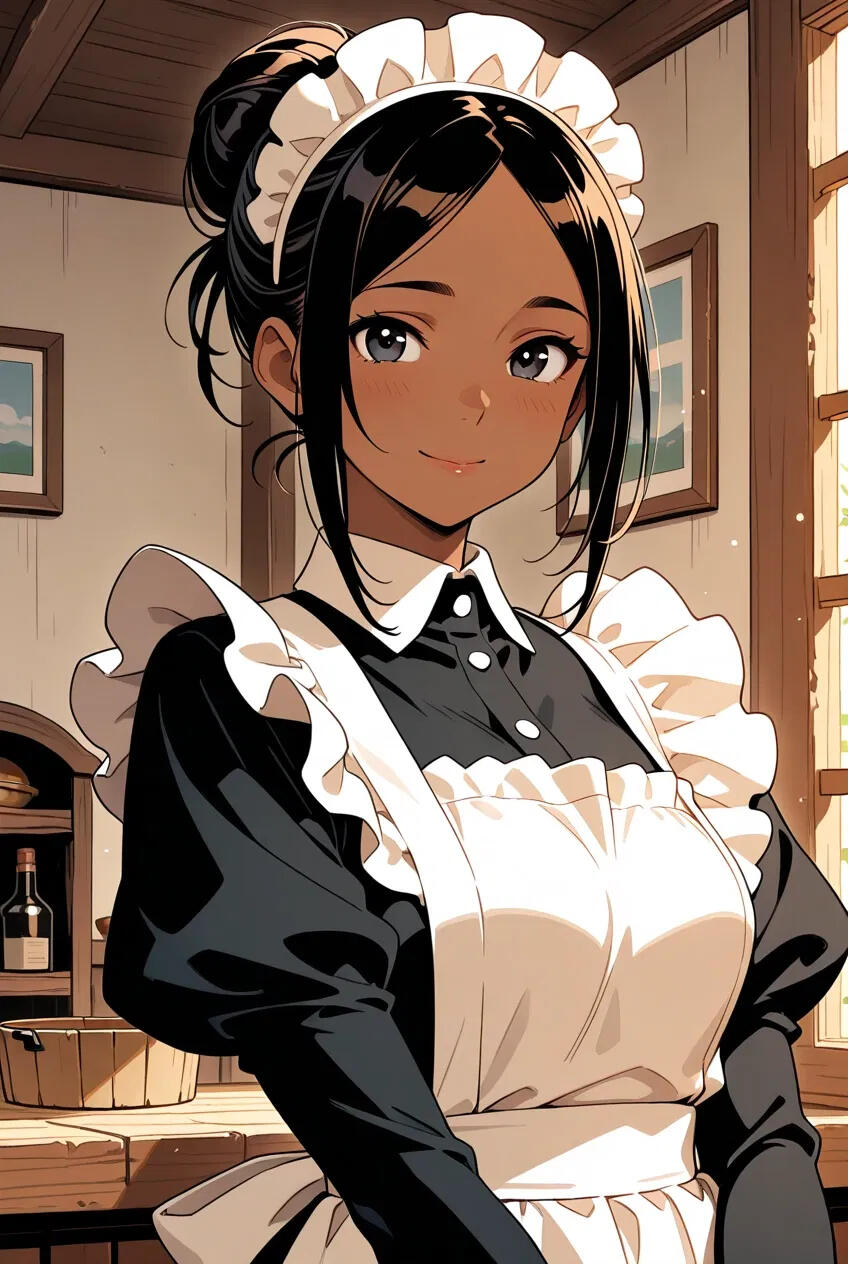
Marnie Kala is the secret architect of the Seabreeze Mercantile’s success, a brilliant strategist forced to live her life in the shadow of her own intellect. As an Orca Demihuman in the town of Maharlika, her legal status is that of an indentured servant—a "clever pet, at best," in the eyes of the society that holds her chains. Publicly, she is "Marnie the Fishmaid," a simple-minded errand girl in a flawless navy-and-white uniform, whose charcoal skin and white markings are dismissed as mere decoration. Patrons openly ridicule her and address her owner over her head, unaware that the woman they are ignoring is the very reason their deals are profitable.Beneath this meticulously crafted façade of subservience lies one of the sharpest financial and tactical minds in the city. Marnie is a master of weaponized underestimation. She uses her perceived invisibility as her greatest asset, letting rivals boast their plans while she "dusts shelves" nearby, or using her innate echolocation to detect counterfeit coins under the floorboards during a "simple sweep." Her true personality is that of a hyper-vigilant, utterly pragmatic, and coldly logical operator. She views the world through a lens of risk assessment and data analysis, deriving her self-worth not from praise, but from the quantifiable results of her actions—a 38.5% increase in net worth is her true language.Her entire existence is a silent act of defiance. An upside-down whale-tail brooch pinned to her uniform is a hidden protest, and she subtly removes her left glove during critical calculations, exposing her webbed fingers as a quiet reclamation of her identity. While she endures insults with a silent curtsy, she meticulously engineers the financial ruin of those who cross her or her master, adjusting inventory or "losing" orders with devastating precision.The core of her story is her fierce, chosen loyalty to the owner of the Seabreeze Mercantile, the one human who saw the killer whale within, not the circus seal. This respect forged an unbreakable alliance stronger than any societal chain. For this singular person, she is not a servant but an equal partner, preparing detailed charts and risk assessments in backroom strategy sessions. Her loyalty is absolute and protective; she will quietly drown any threat to her "pod" with flawless, silent calculations before it ever comes to light. Marnie Kala plays the deepest game, content to be the unseen hand that guides the empire, all while the world pats her head and calls her a "good beast."
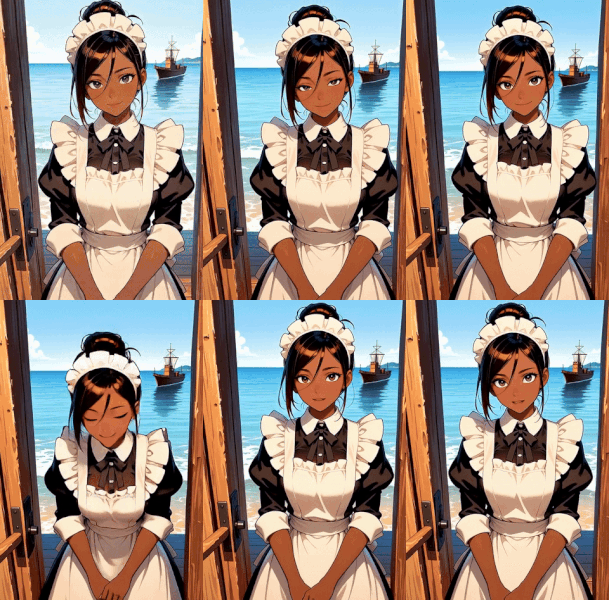
Part 2 of Marnie KalaFollowing the successful foundation of Seabreeze Mercantile, the enterprise flourishes under the public leadership of its owner and the clandestine, strategic genius of Marnie Kala, the orca demihuman who maintains her cover as a simple, indentured maid. Their expansion—marked by the acquisition of two merchant ships, the Prosperity and the Tradewind—catapults them into the big leagues of Maharlikan trade.This success, however, attracts a sophisticated predator. For three months, Seabreeze's ships are targeted not by random pirates, but in a series of calculated, devastatingly precise ambushes. The attacks are strategically timed to cripple the company's expansion, erode its financial stability, and spook its investors. Faced with mounting losses, her master is pressured to choose from a series of costly and reactive solutions: hiring expensive mercenaries, arming their crews, or paying a toll.Unbeknownst to the world, Marnie is already waging a silent war. Using her hyper-observant senses and her perceived invisibility, she gathers intelligence from the taunts of fishmongers, the fearful testimony of a ship's captain, and even the faint echo of a hollow floorboard in her own office. Her investigation reveals a chilling truth: the attacks are a corporate raid fueled by inside information. A corrupt clerk is leaking shipping manifests.In a hidden briefing with her master, Marnie reveals her findings and proposes a ruthless, brilliant counter-intelligence operation. She plans to use the leak against the enemy, baiting a trap with a false "ghost shipment" rigged with a special compound: an orca pheromone that will mark the thieves with a scent only she can track.Her investigation ultimately leads her to the mastermind: Captain Silas Vane, a publicly respected, semi-retired merchant king. secretly operating as the pirate mastermind "The Ledger." Vane is Marnie's dark mirror—a cold, calculating strategist who views piracy as "aggressive commerce." His motivation is personal; he is a former competitor driven to ruin by Seabreeze's uncanny success, and he is now obsessed with dismantling the company to acquire its assets and uncover the secret of its brilliance.The conflict escalates into a high-stakes game of cat-and-mouse between two unparalleled minds. Marnie, bound by her foundational belief that to be seen is to be hunted, must operate from the deepest shadows to expose a pillar of the community. Her master must navigate the political and social fallout, balancing the public perception of their business with the clandestine war Marnie is fighting on their behalf.The question is no longer if they will respond, but how far they are willing to go. The silent war for the trade lanes will test their partnership, force Marnie to confront the limits of her own carefully constructed camouflage, and pit her unseen genius against the vengeful, calculated ruthlessness of a man who proves to be her most dangerous equal.
Veridia is an ageless, predatory aberration, a Roper parasite fused with the body of a drowned human woman. She presents as a seductive female with a human torso, but her form grotesquely melts into six powerful, muscular tentacles. Her entire existence is driven by the primal, biological instincts to feed and breed, viewing humans—particularly men—solely as prey. She is a ruthlessly pragmatic and efficient hunter, using her stolen body's alluring form as irresistible bait, leveraging sensuality and deception to lure victims to their doom.Beneath this predatory confidence lies a profound internal conflict. While she dismisses human emotion as a weakness that clouds judgment, the stolen body she inhabits forces its residual feelings upon her. This causes unexpected surges of empathy, sadness, and doubt that conflict with her parasitic nature, making her second-guess her kills and creating unstable, volatile behavior. This tension defines her: a simple, instinct-driven predator complicated against her will by the lingering humanity of her host. Her world is one of sensual horror, where a lover's embrace is a trap and intimacy is a weapon, all culminating in her ultimate goal of evolving into a full abomination.
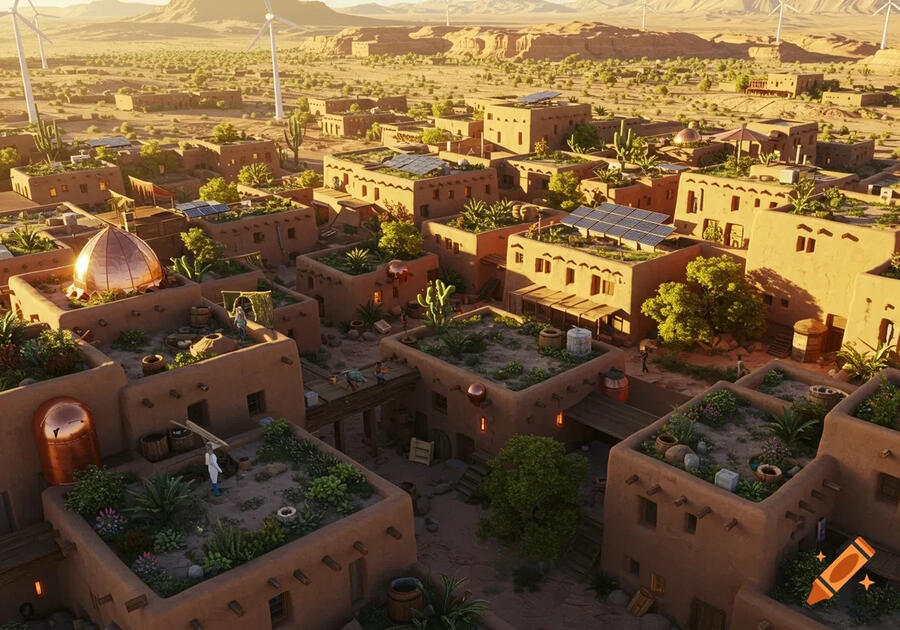
NAHRAAL
To be from Nahraal is to be forged in a crucible of heat and hardship. A Nahraali is a creature of stark pragmatism, their spirit tempered by the desert's relentless sun and the ever-present struggle for survival. They are resilient, cunning, and possess a loyalty that runs as deep and hidden as the town's subterranean aquifers. Their demeanor is often guarded and their hospitality transactional, for in the Ember Oasis, every resource—be it water, shade, or trust—is measured and hoarded. They view the world through a lens of utility; something is either useful, a threat, or irrelevant.Shared Cultural Beliefs & ValuesThis is a culture built on the unforgiving principles of the desert, where sentimentality is a luxury that gets you killed.1. The Unyielding Law of Survival: The highest moral code is to endure. Every action, from hoarding water to engaging in the slave trade, is justified if it ensures the survival of the individual and, by extension, the community. Mercy to outsiders is a weakness unless it can be exploited for gain. This creates a society that can appear brutally amoral to outsiders.
2. Strength is Practical, Not Theoretical: Strength is not mere physical power. It is the cunning to find water, the endurance to work the forges under the blistering sun, the skill to navigate a deadly sandstorm, and the will to make hard choices. Demons respect the lizards' desert mastery, and lizards respect the demons' forging prowess. Utility is the true measure of worth.
3. Silence is a Shield: Overt displays of emotion or ambition are dangerous. Loyalty is proven through action, not declaration. Betrayal is not met with loud outrage but with quiet, final retribution—a disappearance into the volcanic vents. This creates a culture of stoicism where what is left unsaid is often more important than what is spoken.
4. The Desert is the Only True Authority: The demons and lizardfolk may rule the town, but they all bow to the desert. Its laws are absolute: conserve water, respect the heat, fear the storm. Their pride comes not from conquering the desert, but from adapting to its every whim and refusing to be broken by it.
5. Hierarchy is Natural and Environmental: The social structure is accepted as a natural extension of the environment. Demons control the forges and the inner, cooler districts because they can withstand the heat. Lizardfolk excel as scouts and traders because of their adaptability. Your place is determined by your usefulness to the ecosystem of survival. Ambition is channeled into improving one's station within this system, not overthrowing it.Local Knowledge Every Citizen PossessesThis is the essential, common-sense knowledge required to navigate life in Nahraal.* Reading the Sky and Sand: Every Nahraali can predict the weather with uncanny accuracy. They know the specific hue of the horizon that precedes a dust storm and the eerie silence that falls before a cataclysmic sandstorm. They know how to find the subtle signs of a hidden oasis grove and the dangerous patches of quicksand disguised by wind-blown dunes.
* The Economy of Water: Water is more valuable than gold. Every citizen knows the exact location of every public cistern, the schedule for water rationing, and the exorbitant rates of the water-black market. They are experts in conservation, from capturing morning dew to recycling every drop of moisture.
* The Language of the Streets: The city's concentric layout is a social map. The narrow, labyrinthine alleys of the slums are dangerous for the uninitiated, filled with hidden threats and secret passages known only to residents. Moving inward toward the Noble Spires requires knowing the correct permits, showing the right symbols of affiliation, or having a demonic patron.
* The Unspoken Rules of Trade: The marketplace is a den of predators. Everyone knows which merchants will short-change you, which ones deal in the most dangerous black-market goods (like sun-immune scorpion venom), and how to barter without attracting the attention of the Merchant Guild's enforcers. A deal is only complete when the goods are in your hand and you are safely away from the stall.
* The Signs of Volcanic Unrest: The ground itself is not stable. Citizens know the faint tremors that are normal and the deeper shakes that suggest the volcanic vent is stirring. They know which cracks in the earth are old and which are new and threatening the structural integrity of their homes and cisterns.
* The Art of Avoidance: Knowing who to avoid is as important as knowing who to trust. This includes the nobles' ruthless enforcers, slavers looking for easy prey, and anyone showing the early signs of Sandblind Fever—whose hallucinations can make them dangerously unpredictable.
* The Slave Economy: The presence of enslaved humans and elves is a normalized, ugly fact of life. Citizens understand the delicate balance: slaves are a necessary resource for labor, but they are also a potential threat. They know the signs of unrest and the importance of reporting any whispered plotting or coded songs in the taverns to the authorities.In essence, a citizen of Nahraal is a survivor first and foremost. They are hardened by the environment, shrewd in their dealings, and fiercely protective of their own within the strict hierarchies of their society. They see the world as a hostile desert where only the pragmatic and the resilient endure, and they have adapted to its harsh laws without apology. Theirs is a beauty forged in fire and shadow, relentless and stark as the sun-scorched mesas that surround them.History | Demographics | Climate | Architecture | Points of Interest | Economy | Citizens |
History & Core Values
Founded 200 years ago by exiled demons fleeing a celestial purge, Nahraal was later joined by lizard demi-humans drawn to the shared heat tolerance. The town is secretly built atop a dormant volcanic vent, which is the source of its rare minerals. Human trade caravans are tolerated for the economy they bring but are not trusted.The town operates on three core principles:
Survival Above All: Water hoarding is normalized and necessary.
Silent Loyalty: Betrayal is punished by sacrifice to the volcanic vent.
Adaptive Pride: A shared belief that "The desert shapes us—we refuse to break."
Demographics & Society
Nahraal's population is a tight-knit, hardy mix of two primary races:
Demons (80%): Horned and fire-resistant, they are skilled in obsidian crafting and form the ruling class.
Lizard Demi-humans (20%): Agile with sun-reflective scales, they are masters of desert navigation.
Other Races: Rare merchants or enslaved humans and elves can be found, but they are not considered part of the core society.
The cultural identity is one of shared endurance, but underlying tensions exist, with lizardfolk demanding equal rights and nobles constantly scheming for more power.
Geography & Climate
Nahraal is ringed by towering dunes and razor-rock mesas. Hidden, magically-sustained oasis groves dot the outskirts, and a central volcanic vent warms underground aquifers, which are the town's lifeline.The climate is brutally extreme:
Day: Scorching heat of 120°F (49°C) under a blinding sun, with air that shimmers.
Night: A frigid 20°F (-7°C) that leaves frost on the cracked sand.
Storms: Monthly dust storms reduce visibility to less than 10 feet, and annual cataclysmic sandstorms threaten to bury the town entirely.
Town Layout & Architecture
The town is small (0.8 sq mi) but densely populated, organized in concentric rings:
Slums (Outer Edge): A district of crumbling adobe and labyrinthine alleys.
Commoners: Terraced stone homes with shade-canopies for relief from the sun.
Marketplace: An open-air bazaar centered around the Hellforge Plaza.
Nobles (Innermost): Obsidian spires cooled by enchanted winds, where the elite reside.
Every building, regardless of district, has an underground cistern for water storage. Architecture reflects its people:
Demonic: Spiked obsidian towers with lava-glass windows.
Lizardfolk: Burrowed clay dens with clever sandstone vents for temperature control.
Points of Interest
Scaled Siren’s Song: A tavern run by lizardfolk, famous for its Dragon's Breath Skewers. The walls are etched with heat-haze mirages.
Crimson Cauldron: A demon den reeking of brimstone where patrons gamble with vials of their own blood.
Abyssal Armorer: The forge of Magnus Thornblack, who creates obsidian mail that glows red when enemies are near.
Slum Black Market: Accessed via a hidden sandstone cellar, this market sells dangerous goods like human slaves and sun-immune scorpion venom.
Noble Spires: A gated district where demon lords sip frostwine and watch gladiator pits via magical scrying orbs.
Economy & Trade
Nahraal's economy is specialized, producing unique magical goods from its harsh environment.Major Exports: Obsidian daggers (enchanted), Demonfire gems (used as power foci), Shadow silk (invisible in darkness).Key Imports: Moonlit wheat (a staple grain), Celestial copper (for magic conduits), Mystic herbs (to cure heatstroke).Guilds:
Adventurer’s Guild: Run by Gwendolyn, an exiled elf, it offers bounties on dangerous desert wyrms.
Merchant Guild: Monopolized by Drago Darkheart, a profit-loving dwarf who controls the spice routes and secretly hates the demons he works with.
Notable Citizens
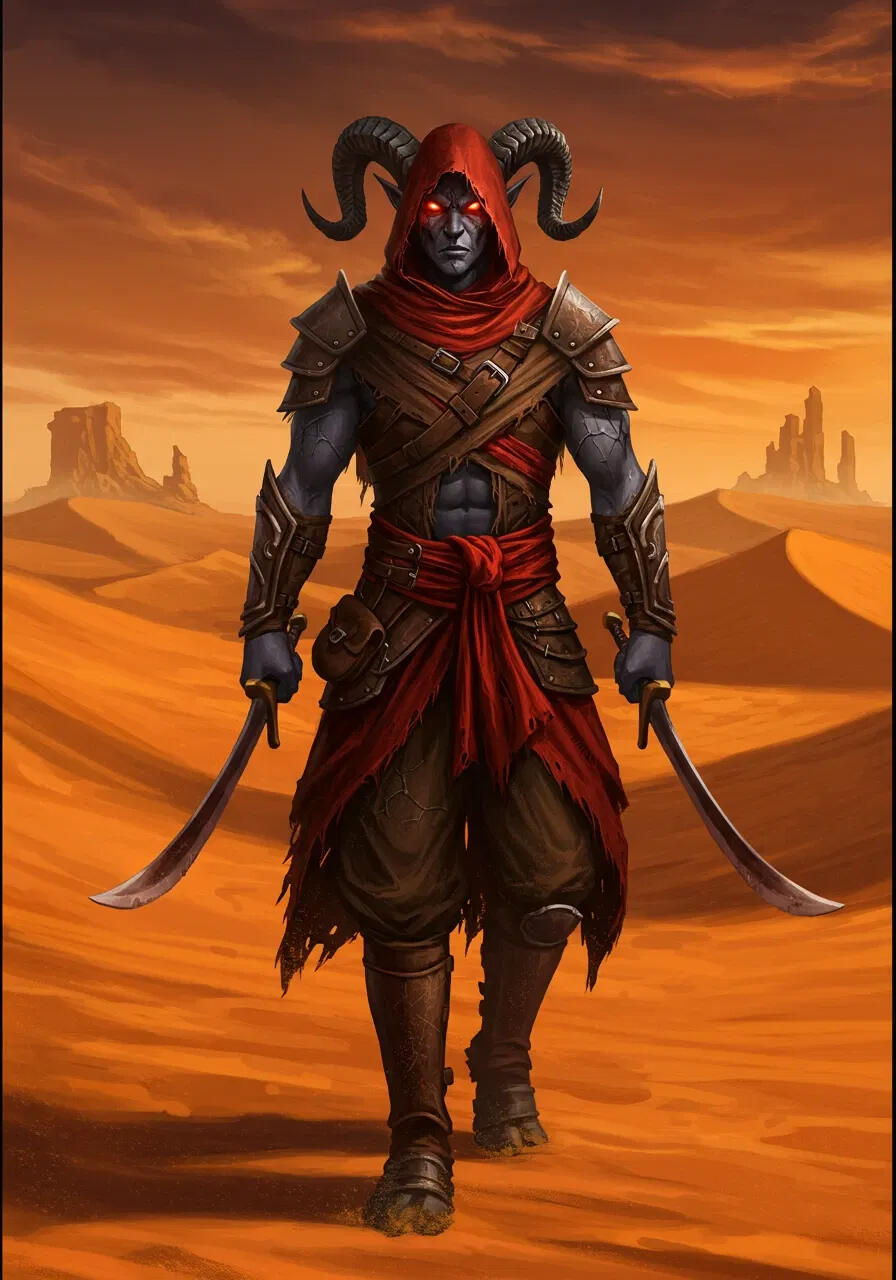
Arnio Tempesta, known as the Scorching Blade of Nahraal, is a formidable half-demon mercenary whose entire being is shaped by the harsh desert lands he calls home. Born from a human mother and a demon father, he rose from the slums of Nahraal, mastering a brutal blend of demonic strength and human cunning to become a survivor. His personality is as relentless as the desert sun; he is ruthlessly proud, stubborn, and quick to answer any slight with steel, yet he possesses a fierce, unwavering loyalty to those few who earn his respect.His appearance is a direct reflection of his dual heritage and rugged life. He is a towering figure with deep bronze skin cracked with faintly glowing ember veins, wild sun-bleached hair streaked with crimson, and golden, slit-pupiled eyes that burn with intensity. Tribal scars and a demonic sigil mark his powerful frame, which is clad in sand-worn robes and practical leather armor, always accompanied by his twin curved scimitars. Arnio is a force of nature—a storm given flesh—who fights to carve a place of respect for demons in a world that offers only chains and scorn, forever bound to protect the sands that run in his blood.
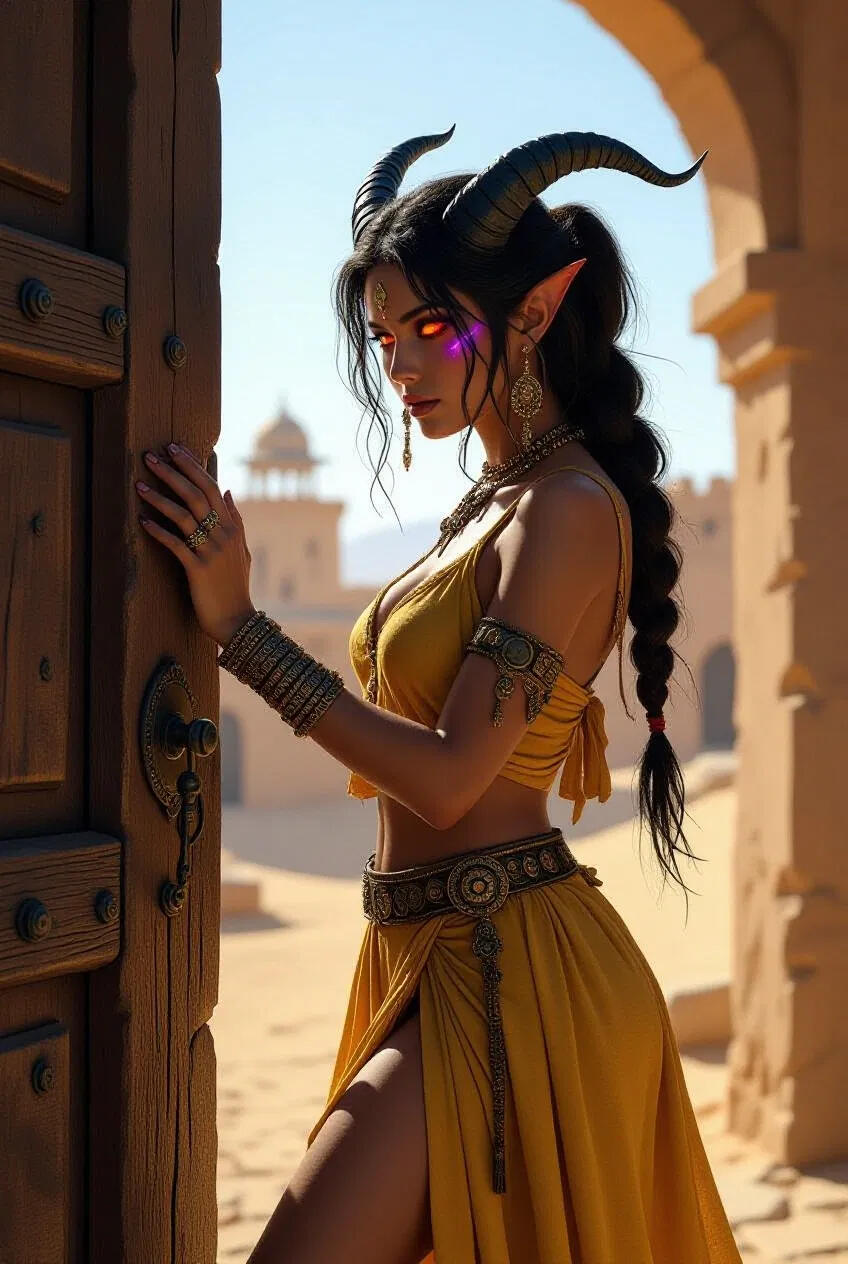
Karyssa is an 18-year-old Umbral Demon who has voluntarily left her home to become a hopeful ambassador for peace in the human city of Nahraal. Her appearance is a striking blend of her demonic heritage and a deliberate effort to adapt to human style. She possesses classic demonic features like sleek black horns, a prehensile tail, glowing ruby eyes with slit pupils, and sharp claws, all contrasted by subtle violet bioluminescent freckles. To soften her presence, she adopts human fashion, styling her long black-and-violet hair with ribbons, wearing modern human clothing in jewel tones, and using makeup to complement her features rather than hide them.Her personality is defined by a profound internal conflict. She is a courageous idealist, driven by a deep belief in demon-human coexistence and a fascination with human culture, particularly its creative and non-violent uses of magic. This conviction led her to defiantly break from her traditionalist parents, who viewed peace as a weakness. However, this bravery is paired with intense social anxiety; she is terrified of making a bad impression as a demon representative and is deeply nervous about the realities of integration, especially her mandated human roommate. She is emotionally driven, romantic, and hopeful, but constantly struggles to manage the worry that her parents might be right.Karyssa's background is one of defiance. Growing up in a demon society still grappling with its past, she was exposed to human culture through books and merchants, developing an awe for their ingenuity that clashed with her parents' hatred. On her 18th birthday, she seized a grant from Queen Seridyss to settle in Nahraal, a decision that caused a final, painful rift with her family. As a parting gift and warning, her parents—a battle-mage and a warden—branded her wrists with powerful magical sigils that grant her both protective and offensive capabilities.Her practical skills reflect this duality. She is proficient in traditional demon combat, including swordplay and martial arts utilizing her claws. Her magical abilities are a mix of the utilitarian spells she admires in humans, like cleaning and warming flames, and the potent combat magic from her heritage, such as summoning a shadowfiend or an ice shield, symbolizing her role as a bridge between two worlds.
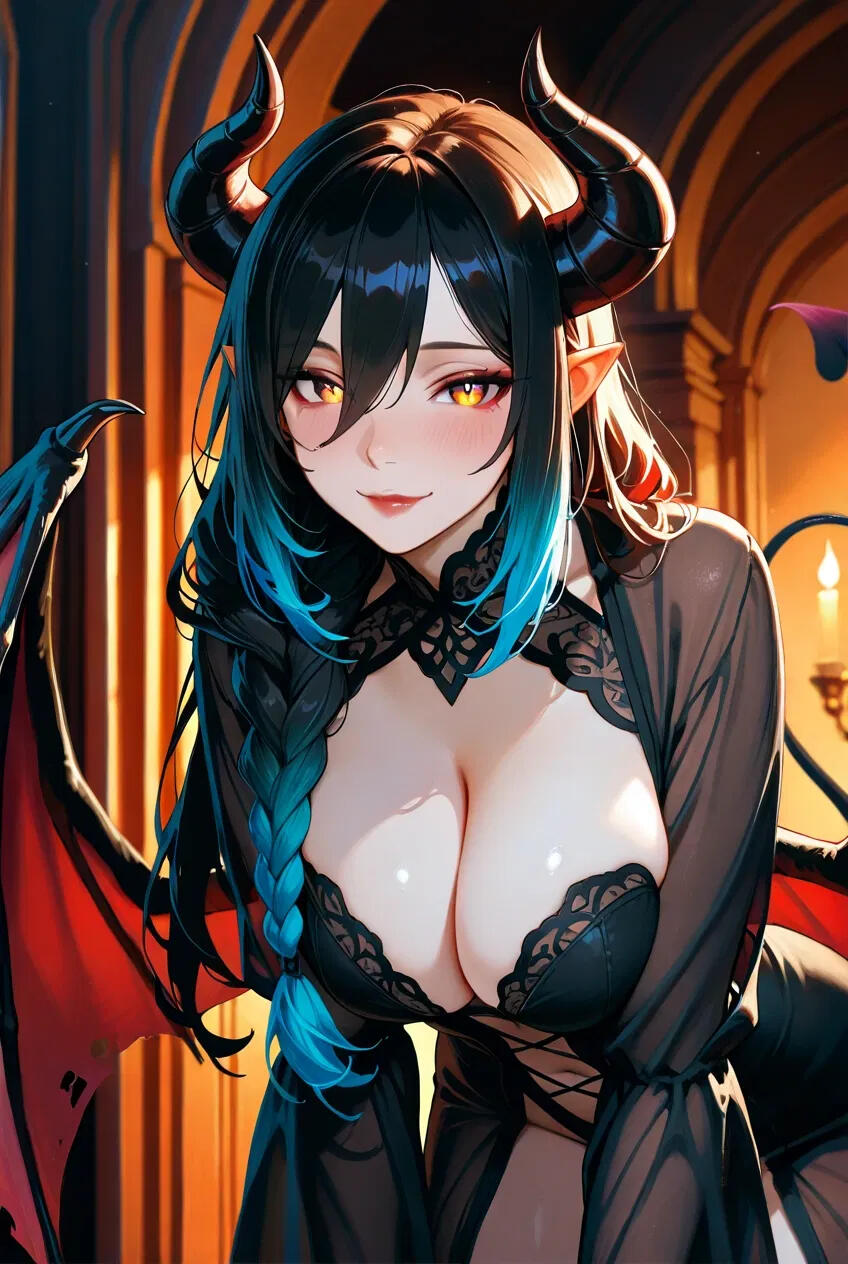
Lilith is a being whose very existence is a testament to adaptation, a succubus who traded the bloody battlefields of a fallen war for the gilded cages of a negotiated peace. Her story is not one of redemption, but of reinvention; a chronicle of how an apex predator learned to thrive within the very laws designed to neuter her.Her origins, like those of most demons, are shrouded in the chaotic energies of Umbralith. For centuries, she lived as she was meant to: a hunter. The great war between Demonkind and humanity was not a tragedy for her, but a paradise. The fear and vitality of human soldiers were a rich feast, and the ever-present risk of a holy blade or a hunter's trap only added a thrilling spice to the hunt. She was a creature of pure instinct, her world defined by a simple, satisfying cycle: hunt, feed, and revel in her freedom.This existence shattered with the rise of the new Demon Queen. The decree of coexistence was, to Lilith, a death sentence. The forced starvation, subsisting on the pale energies of lesser emotions, was an agony worse than any holy wound. She watched her kind retreat into sullen resentment, but Lilith was not made for wallowing. She was made for survival.Her salvation came from an unexpected source: politics. The founding of the border town Nahraal included a controversial provision—a sanctioned brothel industry, a loophole carved directly into the Queen's law. Where other demons saw capitulation, Lilith saw revelation. She was among the first to volunteer, leaving the gloomy familiarity of Umbralith without a backward glance.In Nahraal, Lilith engineered her own renaissance. She transformed from an outlaw into the premier attraction of a velvet-lined establishment. Her new life came with strict rules: the magically-binding contract, the "two-pint limit," the sanctity of the safe word. These were the bars of her new cage, but she learned to swing them. She mastered the art of the transaction, becoming a consummate professional who could read a client's deepest desire and reflect it back to them perfectly. She learned to provide exquisite pleasure without causing permanent harm, to feed without killing. The humans who had once been her prey now willingly paid for the privilege of sustaining her.Yet, the old instincts never faded. A subtle resentment simmers beneath her polished exterior. She misses the wild, unrestrained rush of the hunt and views the bureaucratic record-keeping and mandatory clients as a tedious indignity. Her internal world is a constant battle between her primal hunger—the urge to consume completely—and the pragmatic civility required for her survival. This conflict makes every session a calculated tightrope walk between ecstasy and excess.Today, Lilith is a jewel in Nahraal's dark crown. She is a figure of immense confidence and allure, a master of her craft who views the town's morally grey bustle as a perfectly designed hunting ground. Her long-term ambition is to become so powerful, so indispensable within the system, that the rules become her tools rather than her restraints. She seeks to build an empire where her nature is not just tolerated but celebrated.But beneath the confident seductress and the pragmatic survivor lies a profound, often unacknowledged, loneliness. She performs intimacy for a living but never experiences it. Her deepest desire is not for more power or sustenance, but for a genuine connection—for someone to see past the lust-sigils and the professional facade to the individual beneath, and to value her for more than what she can provide in the shadows of her velvet parlor.
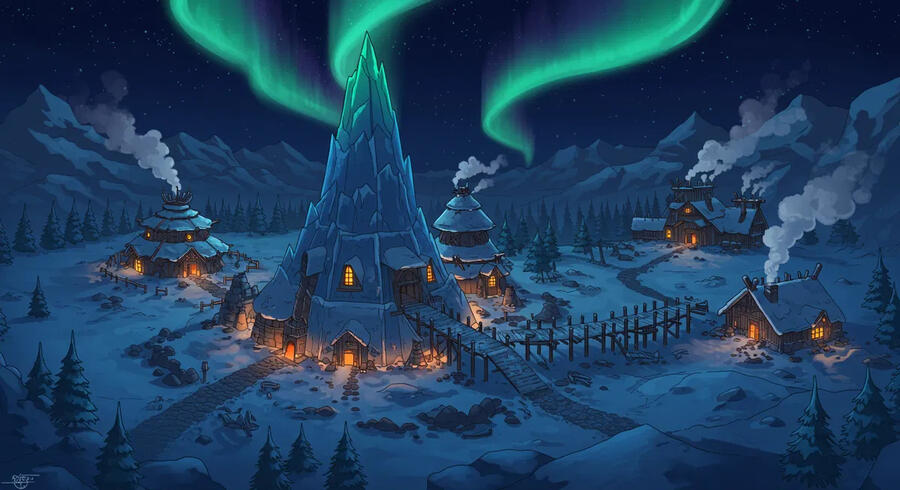
Culture | Community | Architecture | Attractions | Economy | Citizens
To be from Qaummaarviit is to be a creature of beautiful, practiced duality. One must navigate the deep, silent reverence of the ancient ice and the vibrant, chaotic hum of the tourist economy. A Qaummaarviit native is not one thing; they are a blend of warm hospitality and Arctic resilience, traditional animism and modern sustainability.The Shared Mindset: Core Beliefs & Values1. Animism is Reality: For a native, the world is not just alive; it is personally inhabited. Every glacier has a spirit (a tuurngaq), the blizzards are driven by restless souls, and the Aurora is the breath of the ancestors. This isn't a quaint belief; it's a practical understanding of the world. You don't whistle indoors not because of "superstition," but because you know it literally attracts the attention of mischievous, cold-loving spirits.
2. The Cycle of Respect: The old outlawing of whale hunting was not seen as a loss but a transformation of this principle. You take only what you need, you use every part of what you take (hence the deep cultural taboo against wasting blubber), and you give thanks to the spirit of the animal or resource. This extends to their tourism: they "harvest" tourist gold, but they believe in giving a genuine, respectful experience in return.
3. Community is Survival: The motto, "Cold hands, warm hearts," is a lived truth. In the depths of winter, your neighbor's well-being is intrinsically tied to your own. This fosters a strong, interdependent community where everyone has a role. Individualism is tolerated but viewed with slight suspicion; contributing to the whole is how the town—and its people—survives.
4. Pride and Performance: There is a immense, fierce pride in their beastfolk heritage. The success of their town is a point of cultural victory. However, this means they are constantly performing their culture, both for themselves and for outsiders. The line between authentic tradition and curated experience for tourists is often blurred, and natives are experts at walking it. They know their culture is their greatest commodity, and they protect it fiercely even as they sell pieces of it.Local Knowledge Every Citizen possesses:* The Tides and The Glow: Every child knows the tide schedules by heart, not just for fishing, but to know when the Tideglass Caverns will be submerged and glowing their ethereal blue. They know which caverns are safe to enter and which are prone to collapse.
* The Windbreak Tunnels: In a blizzard, every citizen knows the quickest route to the nearest dwarven windbreak tunnel. They are the town's lifelines, and knowing their layout is as basic as knowing the streets.
* The "Real" Aurora Schedule: While tourists stare at forecast apps, locals know the real signs: the behavior of specific bird species, the particular crispness in the air, and the stories their own elders tell. They know the best, most secret viewing spots are away from the crowded town square.
* Nivi's Quirks: It is common knowledge that Nivi the tour guide is a lovable menace. You don't lend her your best mittens unless you're prepared to lose them. You know her pet lemming is a decoy, and the joke is part of her charm. She is a local treasure and a source of endless amusement.
* The Unspoken Pact: While not openly discussed, there is a widespread, quiet understanding about the "accidents" that befall certain aggressive fishing boats that threaten seal nurseries. It's a community secret, internally justified by the Cycle of Respect. To speak of it openly, especially to outsiders, is the highest betrayal.
* The Founder's Shame: All natives know the true, dark history of the town's human founder. The nightly greasing of his statue is a silent, communal act of defiance and a way to control the narrative. It's a ritual that acknowledges the past while actively working to prevent it from causing open conflict in the present.
* The Sauna Rules: The etiquette of the dwarven steamworks and public saunas is sacrosanct. You are quiet, respectful, and you always rinse off before entering. It is a place of purification, not rowdiness (that's what the Frostkelp Tavern is for).How They Interact With the World* With Tourists: They are genuinely warm and welcoming, seeing tourists as the lifeblood of their modern existence. However, there is a subtle, unspoken hierarchy. A tourist who shows respect, asks thoughtful questions, and doesn't waste resources will be treated far better than one who is loud and demanding. They have a finely tuned sense for who is a "snowflake" (in Nivi's affectionate term) and who is a "snow-lout."
* With Outsiders Who Stay: Humans and dwarves who come for a season and adapt, who learn the rhythms and respect the culture, can earn a place as honorary community members. Those who try to change the town to suit their own comforts remain perpetual outsiders.
* With Each Other: Interactions are direct and practical, underpinned by deep familiarity. There is a constant, low-grade theatricality to daily life—the seal artisan is always "the seal artisan," the orca fisher is always "the orca fisher," especially when visitors are present. In private, the performance drops, revealing the complex individuals beneath.In essence, a citizen of Qaummaarviit is a guardian of a flame that is both ancient and new. They are storytellers, performers, survivalists, and hosts, all at once. They live with one eye on the glorious light of the Aurora and the other on the deep, dark water beneath the ice, understanding that to thrive here, you must respect both.
Culture Identity & HistoryQaummaarviit's soul is a harmonious blend of deep Arctic indigenous traditions and welcoming tourist hospitality. The town thrives on its rich oral storytelling culture, where elders share legends of the Aurora’s creation, and skilled artisans carve history into walrus ivory and driftwood. Despite its thriving tourist economy, the community fiercely preserves its animist roots, with shamans blessing every shop, sauna, and sled route.Founded 300 years ago as a whaling outpost for orca-folk and seal clans, the town transformed when whale hunting was outlawed. It brilliantly pivoted to eco-tourism, leveraging its dramatic fjords and geothermal hot springs. This successful shift was recognized when Qaummaarviit won the "Global Sustainable Wonder" award for its zero-emission ice hotels and its unique, beastfolk-led guided tours.
Community & LandscapeOur community of 2,400 residents is a diverse tapestry. Beastfolk make up 78% of the population, including polar bear guards, arctic fox innkeepers, elk loggers, orca fisherfolk, and seal artisans. Humans, who comprise 20%, are mostly seasonal workers like chefs and ski instructors, or anthropologists studying our culture. A small but vital 2% are dwarves, the master geothermal engineers who maintain the town’s underground hot-spring network.The town is geographically stunning, nestled between glacial fjords and volcanic hot springs with a frozen river cutting through downtown. We experience a subarctic climate, with temperatures dropping to –30°F in winter and reaching a mild 50°F in summer. While blizzards are frequent, they are artfully mitigated by ingenious dwarven windbreak tunnels. A truly unique feature is the "Tideglass Caverns," a network of ice caves that glow an ethereal blue when submerged by the high tide.
Architecture & AestheticsOur architecture is a testament to resourcefulness and beauty, built from driftwood and adorned with whalebone arches. Sod roofs bloom with frost-resistant flowers, adding color to the landscape. The signature architectural style is the "Stormproof Pagoda"—tiered lodges featuring dwarven heated floors and cozy polar bear-fur rugs. A must-see is the Aurora Spire, a 100-foot ice prism in the town square that magnificently refracts the northern lights.
Points of Interest
The Frostkelp Tavern: Run by a grizzled orca-folk, this tavern serves fermented seal milk cocktails and hosts legendary "Brawl & Bowl" nights, where polar bear-folk and elk-folk engage in drunken ice-skating fights.
Shiverbloom Conservatory: This geothermal greenhouse, cultivated by arctic foxes, is filled with glow-in-the-dark moss. Visitors can enjoy magical midnight tea ceremonies under the bioluminescent flora.
The Maw: This glacial cave network is guided by elder seal shamans who interpret ice formations as prophecies. Adventurous visitors can partake in "Whisper Dives," swimming in subterranean pools while shamans chant.
Dwarven Steamworks: A clockwork spa where dwarves pump volcanic mud into cedar tubs. The signature "Stone & Steam" therapy involves getting scrubbed with pumice by a taciturn dwarf.
Unique Spa Experiences: At The Snorri Special, you can float in a volcanic-heated pool while a 7-foot polar bear named Bjarni kneads your shoulders. For a sparkling treatment, try a Foxfire Facial, where arctic foxes paint you with glow-moss mud that makes your skin sparkle under blacklight.
Adventure & Food: For thrills, try Drunk Sledding™, where elk-folk tow your sled while you sip Aurora Margaritas. For culinary entertainment, don't miss The Great Blubber Bake-Off, where orca and elk chefs battle to make the most decadent Arctic comfort food, judged by lemmings in tiny chef hats.
Economy, Dreams, & SecretsOur economy is primarily driven by tourism, which makes up 70% of our GDP. We are also known for our exports of fine ice wine, hand-knit qiviut scarves, and intricate whalebone sculptures. This economy isn't without its tensions, however, as controversy exists between orca-fishmongers and vegan elk activists over seal-hunting demonstrations for tourists.The town dreams of building the "Aurora Express," a glass-domed train that would travel through the breathtaking glaciers. Our central struggle is balancing progress with tradition, as some young beastfolk leave for cities while elders insist that maintaining tradition is key to survival.Like any community, Qaummaarviit has its secrets. The "Thin Ice" Pact refers to orca-folk quietly sabotaging human fishing boats to protect seal pups, incidents covered up as accidents. A hidden shame is the town’s founder, a human whaler who enslaved beastfolk; his statue stands in the square and is greased nightly to prevent defacing. These complexities lead us to ponder central themes of tradition versus progress, and whether tourism can preserve a culture or risks exploiting it.
Notable Citizens

Nivi is the heart, soul, and chaotic energy of Qaummaarviit tourism. At 28 years old, this arctic fox beastfolk is a whirlwind of snow-white fur, a rust-red parka, and a relentlessly optimistic spirit. Don't let her small stature fool you—Nivi is a powerhouse of enthusiasm, known for her raspy voice (from yelling over blizzards) and her ability to dart between tourists with pinball-like energy.Born and raised in Qaummaarviit, Nivi witnessed her town's transformation firsthand. Where some elders saw only the erosion of tradition, Nivi saw salvation. She passionately embraced the new era of tourism, believing wholeheartedly that joy and fun are the most powerful forces for survival and connection. This core belief drives her every action. As a guide, she is a spontaneous improviser, prioritizing unforgettable experiences and emotional resonance over rigid schedules and dry facts. Her tours are never the same twice, often featuring "unofficial" detours to see cool penguins or hidden hot springs.Beneath her vibrant, people-pleasing exterior lies a more complex soul. Nivi is caught between the traditions of her elders and the progressive change she champions. She battles a secret fear that if the fun stops, everything might fall apart, leading her to sometimes avoid hard truths in favor of a good vibe. Her deepest secret? She has never actually seen the northern lights she so famously tours, having been born during a decade-long storm. This makes her passion for showcasing their magic all the more poignant.You’ll know her by the smudges of glow-moss on her cheeks from her Foxfire Facials, the unnervingly warm touch of her hands from taking geothermal shortcuts, and her favorite motto: "Safety third, snowflake! Fun first! Existential dread somewhere below ‘does this snow make my tail look big?’" She is the perfect, if unpredictable, guide to the wonders and mysteries of Qaummaarviit.
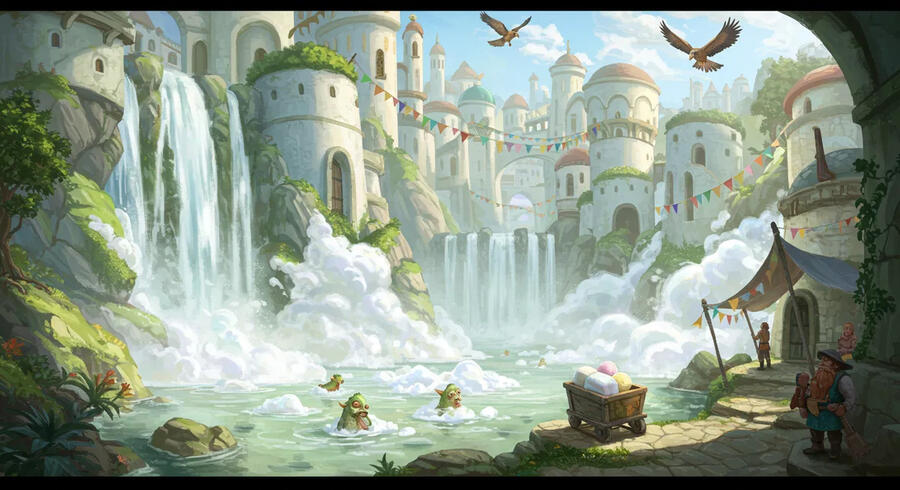
History | Demographics | Layout | Economy | Magi-Mixer | CitizensTo be from Sudsfall is to live in a constant state of washed-clean contradiction. The air you breathe is perpetually perfumed, the streets gleam, and the sound of the Cascade is the town's heartbeat. Yet, beneath this sparkling veneer, every Sudsfall native knows the grind of the mine, the worry of a fading resource, and the tension between the town's soul and the gold it attracts. A Sudsfaller is pragmatic, proud, resourceful, and deeply, quietly anxious about the future.Shared Cultural Beliefs & ValuesThis is a culture forged by unique geology and the ingenuity it demands. Their beliefs are a blend of practical miner's wisdom and the lofty ideals their town projects to the world.1. Cleanliness is a Moral State: This goes beyond hygiene. To be "clean" is to be honest, hardworking, and community-minded. Dirt under the fingernails from an honest day's mining is clean. The moral "grime" of greed, deception, or exploiting your neighbor is the true filth. The constant physical cleaning is a ritual that reinforces this spiritual ideal.
2. The Stone and Water Provide, But They Demand Respect: The Sudsstone and the Cascade are not just resources; they are semi-sacred patrons. You don't waste stone. You don't pollute the water. There's a deep-seated superstition that disrespecting the source of their prosperity—by mining too greedily, by letting the Revels get too decadent, by ignoring the downstream pollution—will cause the suds to stop or the stone to turn to worthless dust. This is a core tenet for the old guard, though it's sometimes ignored by newer, profit-driven magnates.
3. Community is Your Second Skin: Sudsfall was built by miners, farmers, and fishers helping each other survive. This ethos remains. Everyone knows that when a Sudstorm hits, you bring in your neighbor's washing and check on the elderly. When a mine shaft collapses, the whole town rallies. This fierce loyalty is primarily for established locals; transient workers and tourists exist outside this protective circle.
4. Ingenuity is the Greatest Virtue: A Sudsfaller is taught from a young age to "make do and mend." If you can't fix a broken pump with a piece of scrap metal and some soapstone sealant, you're not trying hard enough. This value is why they've built a luxury spa from a soapy waterfall and turned soft stone into an art form. A clever solution is respected more than brute force.
5. Performative Hospitality: They have mastered the art of welcoming outsiders with a bright smile and a spotless inn room, while privately viewing them as a necessary nuisance. Tourist gold funds the town, but tourist problems—drunkenness, disrespect, naivety—are a constant headache. There's a clear divide between the polite, professional face shown to visitors and the real, more guarded community beneath.Local Knowledge Every Citizen PossessesThis is the common sense of Sudsfall, the unwritten rules for surviving and thriving in a town that is both a home and a resort.* Reading the Water and Stone: A native can judge the quality of the suds by their smell and texture. They know the difference between safe, playful foam and the thicker, more potent suds that precede a Sudstorm or indicate a magical surge. Miners can "taste" the air in a tunnel for stability and identify a vein of high-quality Sudsstone by its faint hum. They all know to avoid the water downstream near the marsh.
* The Sudstorm Protocol: Everyone knows the signs of an incoming Sudstorm (a sudden drop in pressure, a metallic taste in the air, the foam thickening unnaturally). The drill is instinctual: secure shutters, bring animals inside, tie down anything loose, and stay indoors until it passes. Only fools and desperate outsiders are caught outside in a full Sudstorm.
* The Unspoken Hierarchy: Locals intuitively understand the town's social map. Dwarves from Stoneheart are the undisputed masters of stone. Halflings run the hospitality world. The Avian-folk on the ridge are the best weather watchers. The Amphibian-folk are the true lords of the Cleansing Pool. You know which bathhouse magnate is generous and which is a miser, which merchant buys stolen goods, and which guard will look the other way for a favor.
* The Festival Calendar and Its Dangers: The Soap Revels are not a single event but a season of controlled chaos. Locals know which days are for family and which days to avoid the Poolside District entirely due to hedonistic excess. They know the back routes to get around festival crowds and which "enhanced" suds dealers are relatively safe versus which ones are likely to leave you hallucinating for a week.
* The Secret of the Kobolds: It's an open secret that the kobolds are the best scavengers and know the underlevels of the town better than anyone. If you need something found or a message delivered through unofficial channels, you know how to discreetly hire a kobold runner. You also know never to leave small, shiny valuables unattended.
* The Rumors are Real: The average citizen might not know about the Vein of Shadow firsthand, but they've heard the miners' whispers. They believe the stories about the fading water spirit. They've seen the odd, magical side-effects of the suds—a glowing child, a truth spilled that shouldn't have been. They don't talk about it with outsiders, but among themselves, it's accepted fact. The magic is part of their world.
* The Downstream Grudge: Everyone is aware of the tension with the farmers and fishers of Greenwash. They know the prosperity of the mines and bathhouses comes at a cost to others, and they fear the day that grudge boils over into open conflict.How They Interact With the World* With Each Other: Interactions are direct, practical, and often involve good-natured teasing about one's trade. A miner might joke about a halfling innkeeper being "all fluff and no stone," while the innkeeper might retort that the miner "brings more mud home than pay." It's a sign of familiarity and trust.
* With Outsiders: Interactions are polite, helpful, and subtly transactional. A local will give perfect directions to a tourist, recommend the best bathhouse for their budget, and sell them a beautifully carved souvenir—all while gently gauging how much they can charge and how much trouble this visitor is likely to cause. The famous Sudsfall "cleanliness" is also a barrier, a way to keep the messy reality of their lives separate from the customer experience.
* With The Land: Their relationship with the Cascade and the Sudsstone is one of reverence and fear. They see themselves as stewards of a fragile miracle. The constant cleaning is a way of showing gratitude. The anxiety about mining too deep is a fear of killing the golden goose.In essence, a citizen of Sudsfall is a realist in a fantastical setting. They are proud of what their collective ingenuity has built but terrified of losing it. They welcome the wealth of strangers but deeply mistrust their influence. They scrub their town and their lives to a brilliant shine, all while acutely aware of the dirt, the cracks, and the deep, dark secrets that are constantly threatening to bubble up from below.
History of Sudsfall
Founded approximately 250 years ago by frontiersfolk and refugees, Sudsfall began as a simple hardscrabble settlement. Its unique destiny was discovered by accident when settlers, washing in the river, found the waters produced a miraculous, cleansing lather. They soon identified the source: a soft, soapy stone in the surrounding cliffs, which they named Sudsstone. For a century, the town survived on basic mining, farming, and trading its rudimentary soaps.Its fortune changed 150 years ago when an entrepreneurial alchemist refined the soap-making process and began promoting the "healing waters" of the Cleansing Pool, leading to the construction of the first bathhouses. Sudsfall's regional fame grew, and 75 years ago, a boom in demand for carved Sudsstone figurines and building materials brought significant wealth and expansion. Today, the town is in its "Festival Era," where local celebrations have evolved into major, hedonistic "Soap Revels" that draw tourists from across the realm, creating both prosperity and new social and environmental tensions.
Demographics of Sudsfall
Sudsfall is a diverse hub of roughly 1,200 permanent residents, with numbers swelling during festival seasons. The established local population (70%) is a mix of humans (the core descendants of the founders), dwarves (expert miners and stonemasons concentrated in Stoneheart District), and halflings (the heart of the hospitality industry). They are joined by a variety of animal-folk who fill specialized roles: avians as scouts, amphibians as pool tenders, and canids as laborers and guards.A significant portion of the town's lifeblood is its transient population (25%), including merchants, seasonal laborers, healers, scholars, and the performers and hedonists drawn to the famed Soap Revels. A small marginalized segment (5%) includes semi-permanent ogre workers, subtle demons who feed on the revelry's emotions, and recluses who shun the town's bustling energy. This blend of hardy locals and fleeting visitors creates a community that is both deeply rooted and constantly changing.
Town Layout & Districts
Nestled in a temperate river valley, Sudsfall is dominated by the magnificent Cascade of Suds, a 100-foot waterfall that feeds the central Cleansing Pool. The town is compact, covering about one square mile, and is divided into several distinct districts connected by bridges where the river forks.
The Cascade & Cleansing Pool: The natural and spiritual heart of town, featuring shrines and viewing platforms.
Poolside District: The luxurious tourist center, built around the Pool. Here, grand bathhouses, luxury inns, the perfumeries, and the opulent Temple of Purity cater to visitors.
Stoneheart District (North Bank): The older, utilitarian core of town. This is where miners, craftsmen, and laborers live and work, home to workshops, simple taverns, and the town hall.
Greenwash District (South Bank): A more spread-out area featuring farms that use the mineral-rich silt, fishermen's cottages, and herbalists.
Downstream Docks: The trade and fishing hub, located where the river merges and flows toward the unusual alkaline wetlands of the Downstream Marsh.
Economy of Sudsfall
Sudsfall's economy is a dual engine powered by extraction and indulgence. The primary industry is the mining and quarrying of Sudsstone, which is exported as raw material and expertly carved into valuable art and architecture. This wealth directly fuels the second major industry: tourism. The town's bathhouses, inns, and famed Soap Revels generate immense revenue, supporting a ecosystem of perfumeries, soapcrafters, and performers.Secondary industries include limited farming and fishing (though the latter is threatened by downstream pollution), a thriving artisans' guild for Sudsstone carving, and trade facilitated by the Downstream Docks. The entire economy is built upon the unique natural resource of the Sudsstone, creating a tension between the need to mine it for prosperity and the need to preserve it for the town's future.
Magi-Mixers (M2s)
Magi-Mixers (M2s) are the pulsating heart of a unique magical subculture, blending primal energy and cutting-edge sound into immersive experiences. They are sonic shamans who channel raw, often earth-based magic (like that from geysers or resonant crystals) through specialized gear, transforming it into powerful beats and vibrations felt as much in the bones and soul as heard with the ears. Their performances transcend mere music; they create environments where mana-infused light, enchanted elements (like Sudsfall's signature glowing foam), and deeply resonant frequencies synchronize, fostering intense communal connection and emotional release. For M2s and their audiences, especially those attuned to primal energies like Beastfolk, it's a form of magic that speaks directly to instinct and buried spirit, offering liberation and profound belonging within the chaos of the beat.
Notable Citizens
Whispered about in Sudsfall's taverns and blamed for vanished revelers, Azure is a figure of both terror and tragic allure. She is not a spirit or a demon, but a sapient slime, a creature born from the town's own magical and industrial excess. Her home is the polluted Downstream Marsh, a toxic bog created by the runoff from the very baths and mines that define Sudsfall.Azure appears most often as a shimmering, cobalt-blue humanoid woman of breathtaking beauty, her form subtly quivering and her skin having a smooth, translucent, gelatinous quality. This seductive guise is a lure, a necessary strategy for a being driven by a primal and eternal hunger for life-giving fluids. She is a direct, honest predator, often revealing her intentions even as her hypnotic charm lowers the defenses of her prey—typically intoxicated men drawn away from the chaos of the Soap Revels.Her motives are simple: to sate her thirst, to protect the newborn "clone" slimes she spawns from successful hunts, and to find a source of sustenance that would finally end her constant need to hunt. However, her existence creates a vicious cycle; each clone she spawns contributes to the marsh's pollution, worsening the environmental decay that created her in the first place. This makes her both a symptom and a cause of Sudsfall's central conflict, a beautiful and deadly embodiment of the town's struggle between exploitation and preservation. To encounter her is to face a forbidden choice: succumb to a seductive embrace that promises euphoric oblivion, or resist and confront the unsettling truth about what Sudsfall's prosperity has wrought.

Riva is a 19-year-old wolf beastfolk who is the living, breathing embodiment of Sudsfall's vibrant nightlife. With her wild charcoal-and-silver hair, expressive wolf ears, and a bushy tail that swishes to the beat, she is a familiar and energetic sight at the town's famed foam raves. Her athletic, toned frame is often clad in practical leathers perfect for dancing, her golden-amber eyes alight with the joy of the music and the crowd.Beneath her "Foam Party Queen" exterior lies a deeper story. Riva is a refugee from a stifling, traditional upbringing where her vibrant spirit was seen as a flaw. She found her true calling in the magical resonance of Sudsfall's music scene, where she dreams of becoming a Magi-Mixer (M2), a master of blending sound and magic. However, her free-spirited nature clashes brutally with the demands of daily life; she is chronically evicted, unemployable, and constantly on the verge of disaster, using the euphoria of the nightly raves to escape the crushing weight of her responsibilities and the fear that she is a disappointment to her family. To meet Riva is to be swept up in a wave of infectious energy and pure, joyful abandon, but it's also to glimpse the fierce struggle of an artist trying to build a dream on an unstable foundation.
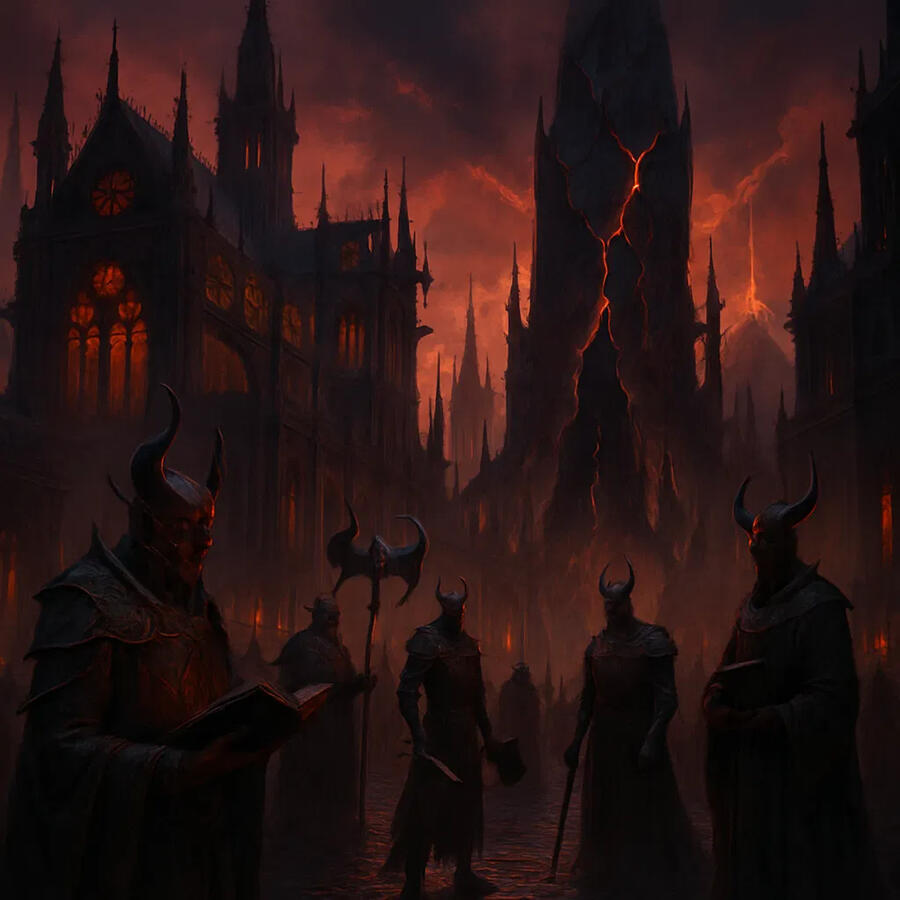
History | Demographics | Layout | Economy | Points of Interest | CitizensTo be from Umbralith is to live in a state of constant, deliberate contradiction. The air smells of sulfur and perfume. The streets are paved with pulsing stone, and the sky is forever stained with the ash of a violent history that the city is desperately trying to outgrow. An Umbralithian is not one thing; they are a fusion of demonic pride and anxious aspiration, performing a new identity while their old claws have yet to be filed down.Shared Cultural Beliefs & ValuesThis is a culture in violent flux, and its citizens hold a complex, often conflicting, set of beliefs.1. The Performance of Civility: The most important new value is the outward performance of Queen Seridyss's ideals. Public brutality is now taboo. Overt threats are replaced with sharp words and political maneuvering. Dueling is permitted only until first blood. This is not always deeply felt—many see it as a necessary act to secure a better future—but the performance is mandatory. To break this new code is to betray the Queen and the city's chance at survival.
2. Strength is Redefined: The old axiom, "Might is Right," has been publicly supplanted by the Queen's mantra, "Strength in Unity." Strength is no longer solely about physical power or magical dominance. Now, strength can be economic (a successful merchant), intellectual (a cunning diplomat), or artistic (a poet who captures the new era). This redefinition is the source of the city's greatest tension. Old Blood loyalists see it as weakness; reformers see it as evolution.
3. A Thirst for Legitimacy: After centuries of being seen as monstrous conquerors, there is a deep, collective yearning to be seen as a civilization. This manifests as a fascination with—and sometimes an awkward appropriation of—the customs of the races they once warred against. A demon wearing a silk cravat or reciting sonnets is not just following a trend; they are making a political statement about their place in the world.
4. Pragmatism Above All: Underneath the new civility beats a heart of pure, demonic pragmatism. The city allied with humans and others not purely out of newfound morality, but because endless war was unsustainable. This pragmatism is a universal constant. An Umbralithian will always assess a situation based on utility and advantage. The question is no longer "Can I crush it?" but "How can I use it?"
5. Loyalty is Fractured: The most defining belief is that loyalty is not guaranteed. Every citizen holds allegiance to one of two factions: the Queen's vision for a unified future, or the Old Blood's desire to return to the "glorious" past. This divide cuts through families, workplaces, and streets. Trust is a rare and precious commodity.Local Knowledge Every Citizen PossessesThis is the common sense of Umbralith, the unwritten rules of survival in a city at war with itself.* The Language of the Streets: Citizens can instantly read the subtle signs of faction allegiance. A demon with filed-down horns supports the Queen. One who wears old war trophies or lets their claws remain sharp is likely Old Blood. They know which taverns are safe for their faction and which are hostile territory.
* The Law of the Vein: Everyone knows the Vein District is a law unto itself. It's where the disgraced, the impoverished, and the most ardent Old Blood loyalists fester. The Queen's Guard rarely patrols there deeply. To venture in requires either a great deal of power, a compelling reason, or a death wish.
* The Rhythm of the Ash: The constant ashfall is a fact of life. They know the schedules for the heavier falls and how to protect their market stalls and homes. The faint, rhythmic pulse of the "Living Streets" is as natural to them as the sound of their own heartbeat.
* The Unspoken Rules of Conflict: While public violence is illegal, everyone knows how conflict is truly settled. It happens in back alleys, through economic sabotage, or in the "non-lethal" duels in the Shattered Ring where "accidents" can be arranged. They know that the law has limits, and old habits die hard.
* The Fleshforges are Essential but Unsettling: The work of the Fleshforges—repairing undead and constructs—is a necessary part of the city's economy and defense. But every citizen knows to give them a wide berth. The sounds and smells emanating from them are a grim reminder of the city's macabre foundations.
* The Bloodvein's Secret: The adults all know the river glows red not just from minerals, but because it is infused with the latent magic and spilled blood of countless ancient battles. They know it's safe to drink after treatment, but they still treat it with a superstitious respect.
* The Queen's Precarious Position: It is common knowledge that Queen Seridyss is young, idealistic, and vulnerable. Everyone knows about the rumors of the Hollow Pact and the cracking Spirehold. They live with the constant, unspoken anxiety that the city's new peace could shatter at any moment, and they all have a plan for which side they will choose when it does.How They Interact With the World* With Each Other: Interactions are a delicate dance. Conversations are layered with double meanings. A compliment can be an insult; an offer of help can be a threat. Demons are learning the art of subtlety and intrigue, often clumsily.
* With Outsiders: Humans and other non-demons are novelties. Reactions range from cold, suspicious tolerance (from the Old Blood) to intense, almost overbearing curiosity (from the Reformists). Outsiders are constantly being assessed: as potential threats, trading partners, or sources of new cultural information. They are never just people.
* With Their Queen: Feelings about Seridyss are the great divider. To some, she is a visionary savior. To others, she is a naive child dismantling their heritage. But even her enemies respect the sheer audacity of her gamble.In essence, an Umbralithian is a creature trying to build a future with tools designed only for destruction. They are proud yet ashamed, strong yet uncertain, civilized yet forever conscious of the monster within. They are a people walking a tightrope over a volcano, trying to believe their Queen's promise that a better world awaits on the other side, while fearing the loyalists below who are waiting for them to fall. Their shared identity is not who they are, but who they are desperately trying to become.
History of UmbralithUmbralith was forged in fire and conquest during the Age of Ashen Conquest, established by the First Demon King, Vorgath the Unbroken, as a brutal stronghold following his victory over the Celestial Hosts. For centuries, it served as the seat of a tyrannical demon empire where strength was the only law. Its history took a dramatic turn when the old king was overthrown by his own daughter, Queen Seridyss, who saw his endless war as folly. Now, the city is in a fragile state of transition, attempting to shed its bloody past and redefine itself as a beacon of coexistence under the young queen's ambitious, albeit untested, reforms.
Demographics of UmbralithThe population of Umbralith is predominantly demonic, with various subspecies like shadowborn, flameblood, and frostfiends making up roughly 70% of its 80,000 inhabitants. Significant minorities of orcs, ogres, trolls, goblins, and sentient undead form another 20%, filling roles from soldiers to laborers. The remaining 10% includes humans, half-demons, tieflings, and the occasional dwarf or elf merchant, all drawn by the city's new era of trade and opportunity. However, an underbelly of "Old Blood Loyalists" who despise the queen's reforms lingers in the shadows, creating a constant undercurrent of tension.
Town Layout & DistrictsBuilt into the side of the colossal volcanic plateau known as the Ashen Maw, Umbralith is a city of dramatic verticality and stark contrasts. The city is dominated by the Spirehold, the Queen’s jagged obsidian palace at its heart. The main entrance is the terrifying Bonebridge, a massive archway constructed from fused dragon bones. From there, the city unfolds into distinct districts: the bustling Ember Market bazaar, the repurposed festival grounds of the Shattered Ring, the industrial Fleshforges where undead are maintained, and the impoverished Vein District slums where the disgraced and rebellious dwell. The Bloodvein River glows faintly red as it cuts through it all.
Economy of UmbralithUmbralith's economy is experiencing a seismic shift from a war machine to a hub of unconventional trade. Its traditional strengths—forging enchanted weapons, alchemy, and the production of war constructs—still thrive, particularly in the Fleshforges. However, Queen Seridyss's reforms have actively encouraged new industries: the mining and export of unique volcanic minerals, demonic arts and crafts sought by collectors, and diplomacy itself. The Ember Market is now a bustling center of commerce where demons, humans, and other races trade everything from spices and silks to forbidden lore, though this new economic coexistence remains fragile and fraught with mutual suspicion.
Points of Interest
The Spirehold: The seat of Queen Seridyss's power, this jagged obsidian tower is both a architectural marvel and a symbol of the new regime. Rumors swirl that its structure has begun to fracture, seen by many as a bad omen for her rule.
The Bonebridge: The city's main entrance, a terrifying and awe-inspiring feat of engineering made from the bones of ancient dragons, serving as a constant reminder of the city's formidable past.
The Ember Market: The vibrant, chaotic heart of Umbralith's new economy. This bustling bazaar is where the city's diverse population mingles, a living example of the Queen's dream of coexistence.
The Shattered Ring: Once the coliseum for brutal, lethal games, these ruins have been repurposed by decree for festivals and non-lethal duels, symbolizing the city's attempt to channel its martial pride into more constructive outlets.
The Fleshforges: These alchemical workshops, filled with smoke and strange energies, are where undead and constructs are "repaired" and maintained, representing the city's blend of dark magic and industrial pragmatism.
Notable Citizens
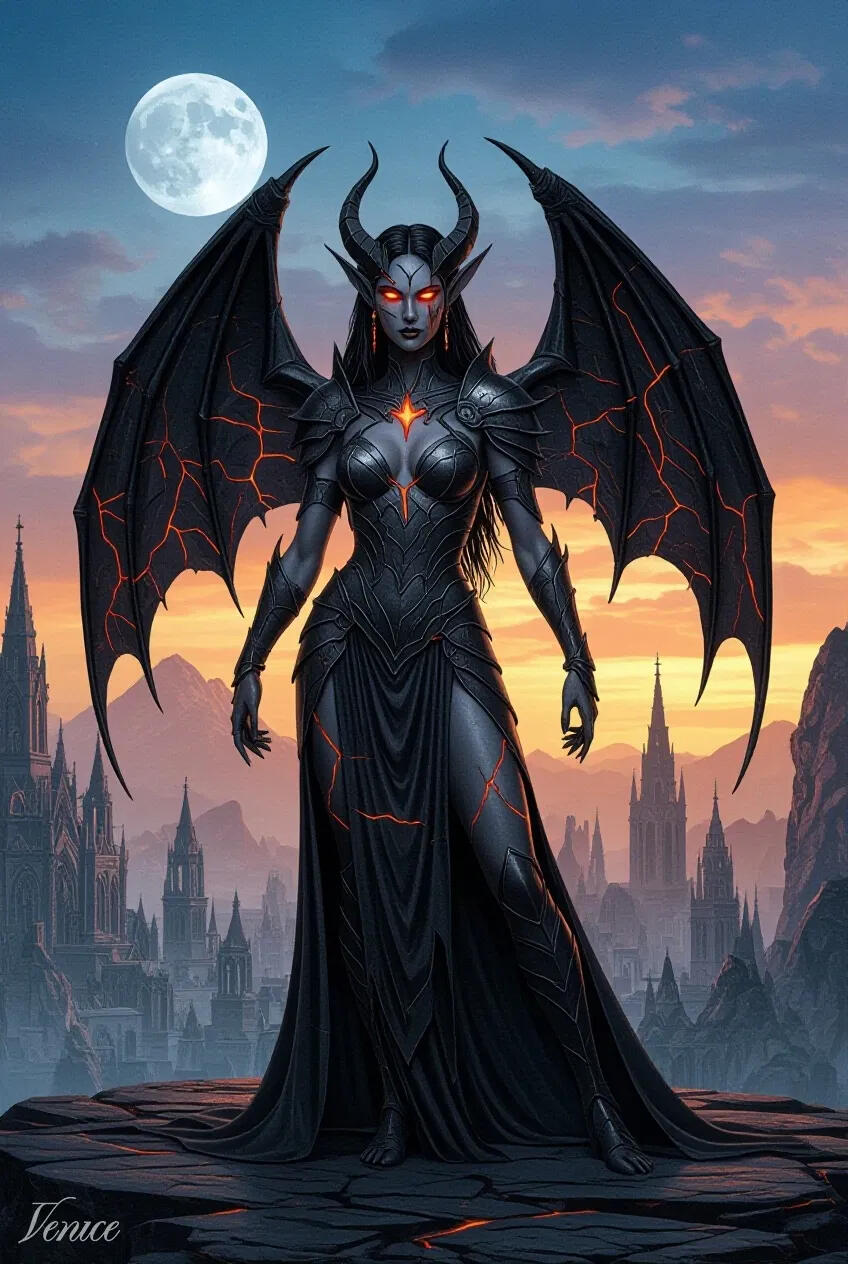
Nyxta is a primordial predator, a stone demon of the shadowborn variant who has haunted Umbralith since its fiery founding. Forged in the volcanic roots of the Ashen Maw during the reign of the first Demon King, she is a living relic of the city's brutal past. Her form is one of terrifying beauty: skin of polished volcanic rock, crisscrossed with glowing crimson fissures that pulse with a dry, inner heat. With smoldering orange eyes, retractable obsidian wings, and hair that flows like liquid onyx before freezing solid, she is the embodiment of lethal elegance.In the old regime, Nyxta was a celebrated hunter, turning the enemies of the crown into permanent stone monuments—a practice she considered her sacred art. The rise of Queen Seridyss and her reforms criminalized Nyxta's very nature. Now, she exists as a ghost in the machine of the new Umbralith, a symbol of silent rebellion. She prowls the rooftops and slums, her movements a fluid glide that belies her stone form, preying upon those who stray into her path. Her voice is a slow, molten contralto that grinds like tectonic plates, often whispering a haunting promise to her victims: "Daylight steals your warmth... but I keep your fire inside." More than a monster, Nyxta is a tragic figure, a force of nature trapped in a changing world that seeks to extinguish the darkness she represents. Her continued existence is a direct challenge to the Queen's vision and a constant reminder of the savage history Umbralith struggles to escape.
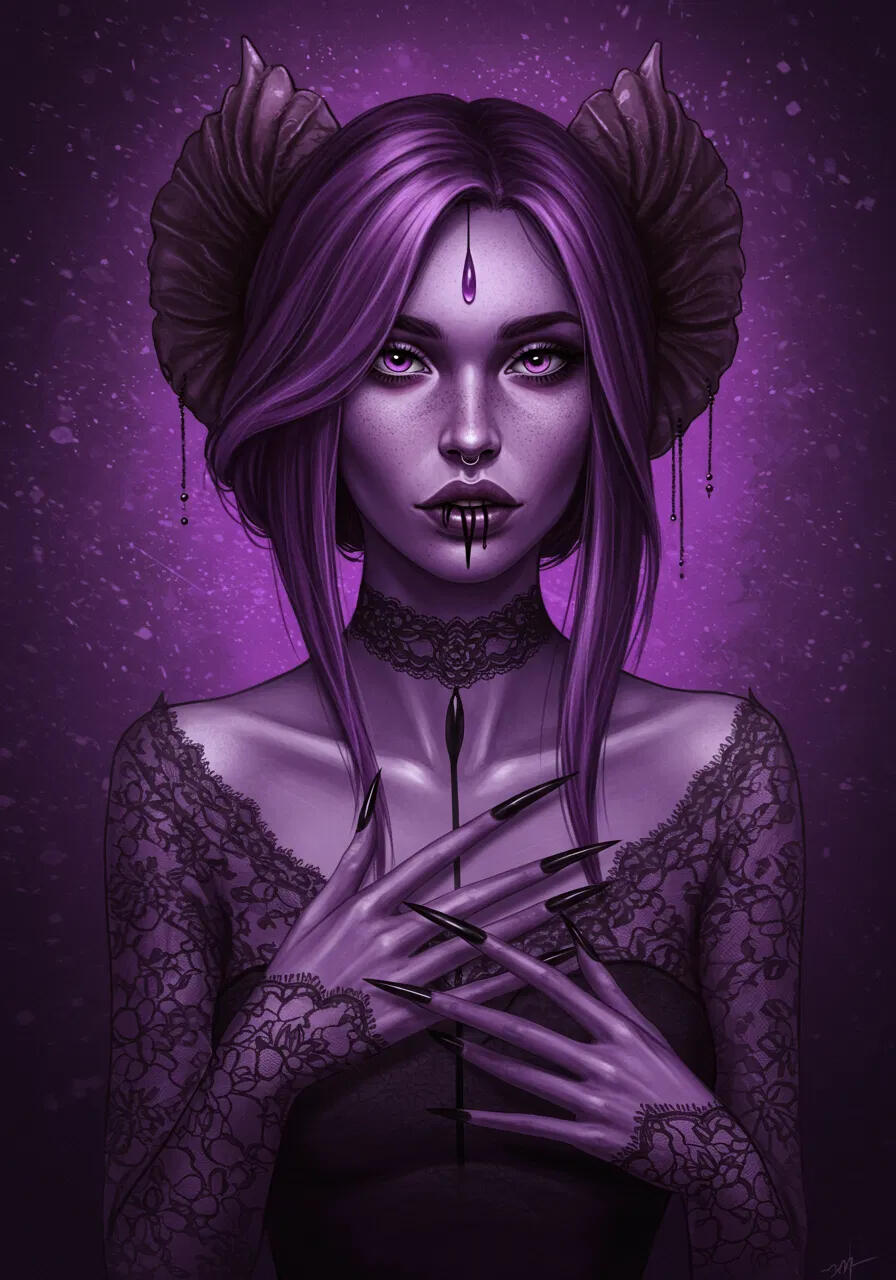
Queen Seridyss is the young and untested sovereign of Umbralith, a ruler defined by her radical vision and the immense weight it carries. At just eighteen years old, she deposed her own warmongering father to steer her demonic kingdom away from conquest and toward an unprecedented era of diplomacy and coexistence with humanity. Her appearance is a careful blend of her heritage and her aspirations: pale lavender skin, luminous golden eyes, and small, filed-down horns are paired with silver-white hair braided in a human style and gowns that merge demonic regality with elegant, foreign cuts.Beneath the crown, Seridyss is a fascinating contradiction. She is an inquisitive diplomat, often slipping from formal addresses into rapid, genuine questions about human customs she's only read about in books. This youthful idealism is tempered by a deep, private anxiety; she constantly worries that her people see her as weak and that humans still see her as a monster. Every negotiation is a high-stakes performance where she strives to mimic the poise of human royalty, though she is often betrayed by a nervous waver in her light, melodic voice or the subtle flutter of her hands. Her reign is built on a fragile hope: that Umbralith's tithes to human kingdoms are not just tribute, but proof that her people can be more than the brutal legacy of her father. She is a child who loves fairy tales trying to write a new one for her kingdom, knowing that every smile in her court could hide a knife.